

Many business owners believe account verification is just filling out forms and uploading documents. In reality, 60% of verification delays stem from complex data mismatches and multi-registry cross-checks. Understanding how business account verification actually works helps European SMEs and startups navigate faster account setup, reduce compliance risks, and access the financial infrastructure essential for cross-border operations.
Table of Contents
- Understanding Business Account Verification: Definition And Purpose
- Core Steps And Documentation Required For Business Verification
- Complexities In Cross-Border Verification For European Smes
- Technological Innovations Streamlining Verification Processes
- Common Challenges And Misconceptions In Business Account Verification
- Practical Tips For Smes And Startups To Navigate Verification Efficiently
- Streamline Your Business Banking With Bankz
Key Takeaways
| Point | Details |
|---|---|
| Compliance Foundation | Verification ensures AML compliance and beneficial ownership transparency as mandated by EU directives. |
| Cross-Border Complexity | International verification adds 30-40% complexity and extends timelines significantly. |
| Fintech Advantage | Automated solutions boost SME approval rates by 40% while reducing compliance costs by 25%. |
| Common Delays | Data inconsistencies, outdated documents, and registry mismatches cause most verification bottlenecks. |
| Strategic Preparation | Accurate documentation and technology adoption streamline the entire account setup process. |
Understanding Business Account Verification: Definition and Purpose
Business account verification is a structured process that confirms a company's legal existence, validates ownership structures, and verifies authorized representatives. This isn't administrative theater. Financial institutions must comply with Anti-Money Laundering and Counter-Terrorism Financing regulations under EU law.
The verification framework examines multiple validation layers. First, it confirms your business entity is registered properly and operating legally. Second, it identifies individuals who hold beneficial ownership above 25% or exercise controlling interest per the EU's 5th AML Directive requirements. Third, it validates authorized signatories who can execute transactions on behalf of the company.
These compliance objectives protect the broader financial system from illicit activities while establishing trust between your business and banking partners. For SMEs looking to setup business accounts in Europe, understanding verification requirements upfront prevents costly delays.
The verification process examines several critical components:
- Legal entity status and registration documents from official government registries
- Beneficial ownership structure including all individuals exceeding the 25% threshold
- Identity verification of owners and authorized signatories through government-issued documents
- Proof of business address and operational legitimacy
- Risk assessment based on industry, transaction patterns, and jurisdictional factors
Each layer serves a specific compliance purpose. Understanding SEPA and IBAN significance becomes particularly important when verification extends to cross-border payment capabilities. The AML and CTF directives establish minimum standards, but individual member states often implement additional requirements that affect verification complexity.
Core Steps and Documentation Required for Business Verification
The verification workflow follows a sequential structure that builds from basic entity confirmation to comprehensive compliance screening. Each step requires specific documentation and validation.
-
Initial Application and Entity Validation: Submit your official business registration certificate from the relevant national registry. This document must be current, typically issued within the last three months, and clearly show your company name, registration number, legal structure, and registered address.
-
Beneficial Ownership and Signatory Identification: Provide government-issued identification documents for all beneficial owners and authorized signatories. This includes passports or national identity cards plus proof of residential address dated within the last three months, such as utility bills or bank statements.
-
Automated and Manual Compliance Screening: Your application undergoes automated checks against sanctions lists, politically exposed persons databases, and adverse media screening. Financial institutions also conduct manual reviews for risk assessment based on your industry, transaction volumes, and jurisdictional factors.
-
Approval or Additional Information Requests: Institutions either approve your application or request clarifying documentation. Response time to these requests significantly impacts your overall timeline.
The documentation package must demonstrate consistency across all sources. Your business name must match exactly across registration documents, ownership declarations, and operational evidence. Address discrepancies between different documents trigger additional verification steps.
Key documents required include:
- Certificate of incorporation or business registration from government registry
- Articles of association or equivalent formation documents
- Proof of registered business address through lease agreements or utility bills
- Complete beneficial ownership disclosure identifying all individuals above 25% ownership
- Government-issued photo identification for all beneficial owners and signatories
- Proof of residential address for all identified individuals
- Business licenses if operating in regulated industries
Accuracy matters more than speed during preparation. One inconsistent detail can restart the entire verification cycle. Institutions compare your submitted data against multiple registries and databases. Essential business registration documents must be properly certified or apostilled when used outside their country of origin.
For businesses pursuing international business banking, this documentation forms the foundation for accessing multi-currency capabilities and cross-border payment infrastructure.
Complexities in Cross-Border Verification for European SMEs
Cross-border business account verification requires additional scrutiny and currency-specific compliance, increasing complexity by 30-40%. When your SME operates internationally or seeks multi-currency capabilities, verification extends beyond domestic standards.

EU member states maintain harmonized minimum standards through directives, yet implementation varies significantly. A business registered in Estonia faces different verification procedures in France than in Germany. These jurisdictional nuances create unpredictable timelines and documentation requirements.
Data consistency becomes exponentially harder across borders. National business registries use different formats, update frequencies, and accessibility levels. Financial institutions must reconcile information from multiple sources, and 15-20% of European SME applications get flagged for extra review due to registry data inconsistencies.
Key cross-border complications include:
- Currency-specific compliance requirements for each currency your account will hold or transact
- Language barriers requiring certified translations of official documents
- Apostille or equivalent authentication for documents used outside their country of origin
- Extended validation timelines when institutions must contact foreign registries directly
- Varying interpretations of beneficial ownership thresholds and disclosure requirements
| Factor | Domestic Verification | Cross-Border Verification |
|---|---|---|
| Average Timeline | 5-7 business days | 10-20 business days |
| Documentation Volume | Standard package | Enhanced with translations and authentication |
| Manual Review Rate | 5-10% | 15-20% |
| Compliance Layers | National AML/CTF | National + currency-specific + cross-border |
| Approval Complexity | Single jurisdiction | Multiple jurisdictions and regulatory frameworks |
These challenges directly impact SMEs pursuing multi-currency account benefits. The verification burden increases with each additional currency and jurisdiction your business touches. However, successfully navigating cross-border verification unlocks substantial operational advantages and market access.
Technological Innovations Streamlining Verification Processes
Fintech and RegTech solutions have transformed business account verification from a manual, weeks-long process into an automated workflow. Automated KYC and business verification increased SME approval rates by 40% while reducing compliance costs by 25%.
Modern verification platforms leverage several technological capabilities. Optical character recognition extracts data from uploaded documents instantly, eliminating manual data entry errors. Machine learning algorithms compare submitted information against multiple databases simultaneously, identifying inconsistencies in seconds rather than days.
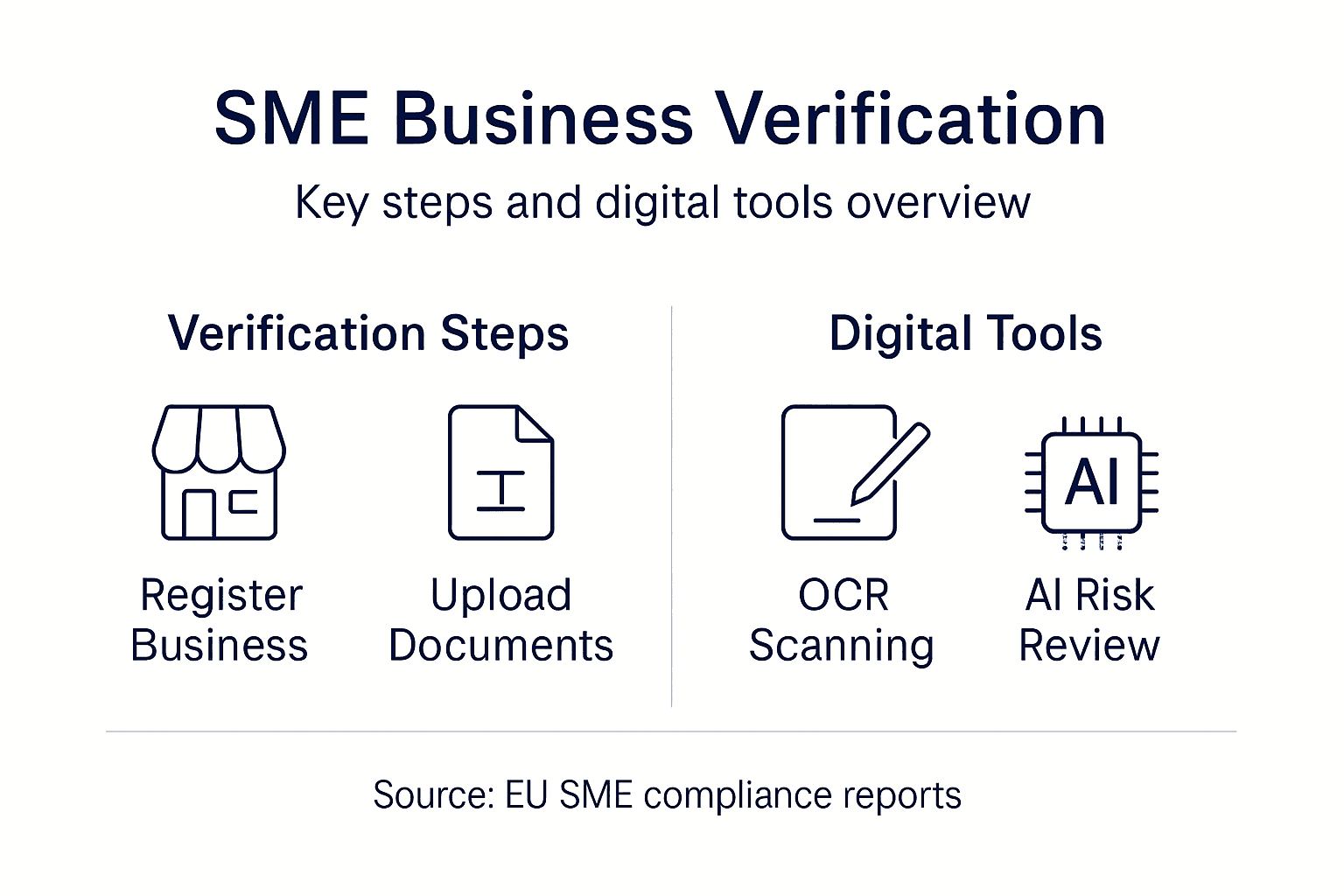
Artificial intelligence enhances risk assessment accuracy. Advanced systems analyze transaction patterns, industry risk profiles, and jurisdictional factors to generate comprehensive risk scores. This automated screening catches suspicious activities faster than manual review while reducing false positives that delay legitimate applications.
Digital identity infrastructure revolutionizes the verification timeline. eIDAS-compliant digital signatures shorten verification turnaround by up to 30%. These cryptographically secured identity proofs allow financial institutions to validate signatories without requiring physical document submission or in-person meetings.
Key technological advantages include:
- Real-time document verification through automated registry connections
- Biometric identity confirmation through facial recognition and liveness detection
- Blockchain-based credential verification eliminating redundant checks across institutions
- API integrations connecting business registries directly to verification systems
- Continuous monitoring capabilities that flag changes in ownership or risk profile post-approval
Fintech platforms designed for SMEs integrate these technologies into seamless online banking solutions. You complete verification through guided digital workflows rather than navigating complex paper processes. Automated systems provide real-time status updates and specific guidance when additional documentation is needed.
Pro Tip: Choose fintech providers that embed compliance automation directly into their account opening process. Platforms with integrated KYC, AML screening, and digital identity verification complete checks in 24-48 hours rather than the traditional 7-10 days. This speed advantage proves critical when launching time-sensitive operations or responding to market opportunities.
The benefits of business bank accounts in the digital age extend beyond faster verification. Automated compliance monitoring reduces your ongoing administrative burden while maintaining regulatory standards. Smart systems flag potential issues before they become compliance violations, protecting your business reputation and banking relationships.
Common Challenges and Misconceptions in Business Account Verification
Many SMEs underestimate verification complexity until delays disrupt their operations. 60% of verification delays stem from data mismatches and multi-registry validation issues, not from institutional inefficiency.
The most persistent misconception treats verification as simple paperwork submission. Business owners assume uploading documents completes the process. In reality, institutions conduct extensive background checks, cross-reference multiple databases, and perform risk assessments that extend far beyond document review.
Common pitfalls that extend verification timelines:
- Submitting outdated business registration documents or expired identification
- Incomplete beneficial ownership disclosures missing individuals just above the 25% threshold
- Address inconsistencies between business registration, proof of address, and owner identification
- Missing or improperly authenticated documents for cross-border applications
- Slow responses to requests for additional information or clarification
Data mismatches between national business registries and submitted documentation account for the majority of verification delays, with 15-20% of applications requiring manual review to resolve inconsistencies.
Another misconception assumes all EU banks follow identical verification procedures. While directives establish minimum standards, implementation varies significantly. Some institutions require notarized translations for foreign documents while others accept certified copies. Risk appetite differences mean one bank might approve your application quickly while another requests extensive additional documentation.
Cross-border complexity remains consistently underestimated. SMEs pursuing international operations often discover additional requirements only after submitting applications. Currency-specific compliance, enhanced due diligence for certain jurisdictions, and extended validation timelines catch businesses unprepared.
Pro Tip: Before submitting your application, verify that all ownership percentages match exactly across every document, business registry entries reflect current information, and addresses use consistent formatting. Spend an extra hour checking details to save weeks of verification delays. Review your documentation with the same scrutiny the compliance team will apply.
Understanding these challenges helps you prepare properly from the start. SMEs that invest time in thorough preparation before submission complete verification significantly faster than those treating it as a quick administrative task. Following business account setup tips systematically reduces friction and accelerates your access to essential banking infrastructure.
Practical Tips for SMEs and Startups to Navigate Verification Efficiently
Successful verification requires strategic preparation and systematic execution. Follow these steps to minimize delays and maximize approval probability.
-
Gather Complete Documentation Before Starting: Compile all required documents in advance rather than submitting partial applications. Ensure business registration certificates are current, typically dated within the last three months. Verify that identification documents for all beneficial owners and signatories remain valid with at least six months until expiration.
-
Validate Beneficial Ownership Accuracy: Calculate ownership percentages precisely, including indirect holdings through other entities. Map your complete ownership structure to identify everyone exceeding the 25% threshold. Include individuals with controlling interest even if their ownership percentage falls below 25%.
-
Choose Technology-Enabled Banking Partners: Select institutions or fintech platforms that leverage automated verification systems. Digital-first providers complete checks in 24-48 hours compared to traditional banks requiring 7-10 days or longer. Platforms with integrated compliance automation reduce documentation requirements and streamline workflows.
-
Research Jurisdiction-Specific Requirements: If pursuing cross-border capabilities, investigate requirements for each relevant jurisdiction. Confirm whether documents need apostille authentication, certified translations, or additional supporting evidence. Understanding requirements upfront prevents surprise delays mid-process.
-
Respond Immediately to Information Requests: Institutions typically allow 5-7 days for responses to additional information requests. Faster responses accelerate your timeline while demonstrating operational competence and legitimacy. Delay signals potential issues and may trigger enhanced due diligence.
-
Maintain Document Consistency: Ensure your business name, address, and ownership structure match exactly across all submitted documents and public registries. Even minor variations in formatting or abbreviations trigger additional validation steps. Review registry entries and update any outdated information before applying.
Pro Tip: Leverage digital identity tools like eIDAS signatures when available. These cryptographically secured identity proofs streamline signatory verification and demonstrate technological sophistication. Many fintech platforms accept eIDAS credentials, reducing verification time by days or weeks.
The most effective approach combines thorough preparation with strategic provider selection. SMEs that choose online banking solutions purpose-built for their needs avoid unnecessary complexity while accessing advanced capabilities. Modern platforms guide you through verification systematically, flagging potential issues before submission and providing real-time status visibility throughout the process.
Streamline Your Business Banking with Bankz
Navigating verification complexity doesn't have to slow your business growth. Bankz delivers fintech-powered solutions that reduce verification time while providing the multi-currency capabilities European SMEs need. Our automated compliance systems process applications in 24-48 hours, not weeks.
Access multi-currency accounts designed specifically for cross-border operations. Manage SEPA, SWIFT, and local GBP payments from one unified dashboard. Our integrated digital tools handle verification requirements efficiently while maintaining full regulatory compliance.
Experience international business bank accounts that combine speed with sophisticated functionality. Start with simple account setup, then scale into business debit Visa cards and advanced multi-currency features as your operations expand. We handle the compliance complexity so you can focus on building your business.
FAQ
What is business account verification?
Business account verification confirms your company's legal existence and validates ownership structures to comply with EU Anti-Money Laundering regulations. Financial institutions examine your business registration, beneficial ownership above 25%, and authorized signatories through document review and database cross-checks to prevent fraud and ensure regulatory compliance.
How long does business account verification typically take for SMEs?
Traditional verification processes require 7-10 business days for domestic applications and 10-20 days for cross-border accounts. Fintech platforms reduce verification time from 7-10 days to 24-48 hours through automated KYC systems, digital identity verification, and real-time database connections that eliminate manual processing delays.
What documents are required for business account verification?
You must provide official business registration certificates, articles of association, proof of registered business address, complete beneficial ownership disclosure, government-issued photo identification for all owners and signatories, and proof of residential address for individuals. All documents must be current, typically dated within three months, and show consistent information across sources to avoid validation delays.
Why is cross-border business account verification more complex?
Cross-border verification complexity increases by 30-40% due to currency-specific compliance requirements and varying regulatory implementations across EU member states. Institutions must validate information across multiple national registries using different formats, often requiring document translations and apostille authentication, which extends timelines and increases manual review rates from 5-10% to 15-20% of applications.