

Many business owners assume cross-border payments are smooth and straightforward in our connected world. Yet cross-border payments remain costly, slow, and opaque, with hidden fees and complex compliance requirements frustrating SMEs daily. Understanding IBAN accounts can transform how your business handles international transactions, cutting errors and accelerating settlements. This guide explains what an IBAN account is, how validation works, and why virtual IBANs are becoming essential tools for efficient cross-border banking in 2026.
Table of Contents
- What Is An IBAN Account And Why Does It Matter?
- The Structure And Validation Of IBANs: How To Ensure Accuracy
- Understanding Virtual IBANs (vIBANs) And Their Benefits For SMEs
- Challenges Of Cross-Border Payments And How IBAN Usage Helps Overcome Them
- Optimize Your Business Banking With Bankz Solutions
Key takeaways
| Point | Details |
|---|---|
| IBANs standardize identification | International Bank Account Numbers use a universal format that improves payment accuracy across borders. |
| Validation prevents errors | Multi-layered checks including the MOD-97 algorithm catch nearly all data entry mistakes before payment. |
| vIBANs enable flexibility | Virtual IBANs allow multi-currency payments without opening multiple physical accounts. |
| Cross-border challenges persist | Despite modern tools, international payments face delays and costs that IBANs help mitigate. |
| SMEs gain efficiency | Understanding IBAN structure and usage reduces operational friction in international banking. |
What is an IBAN account and why does it matter?
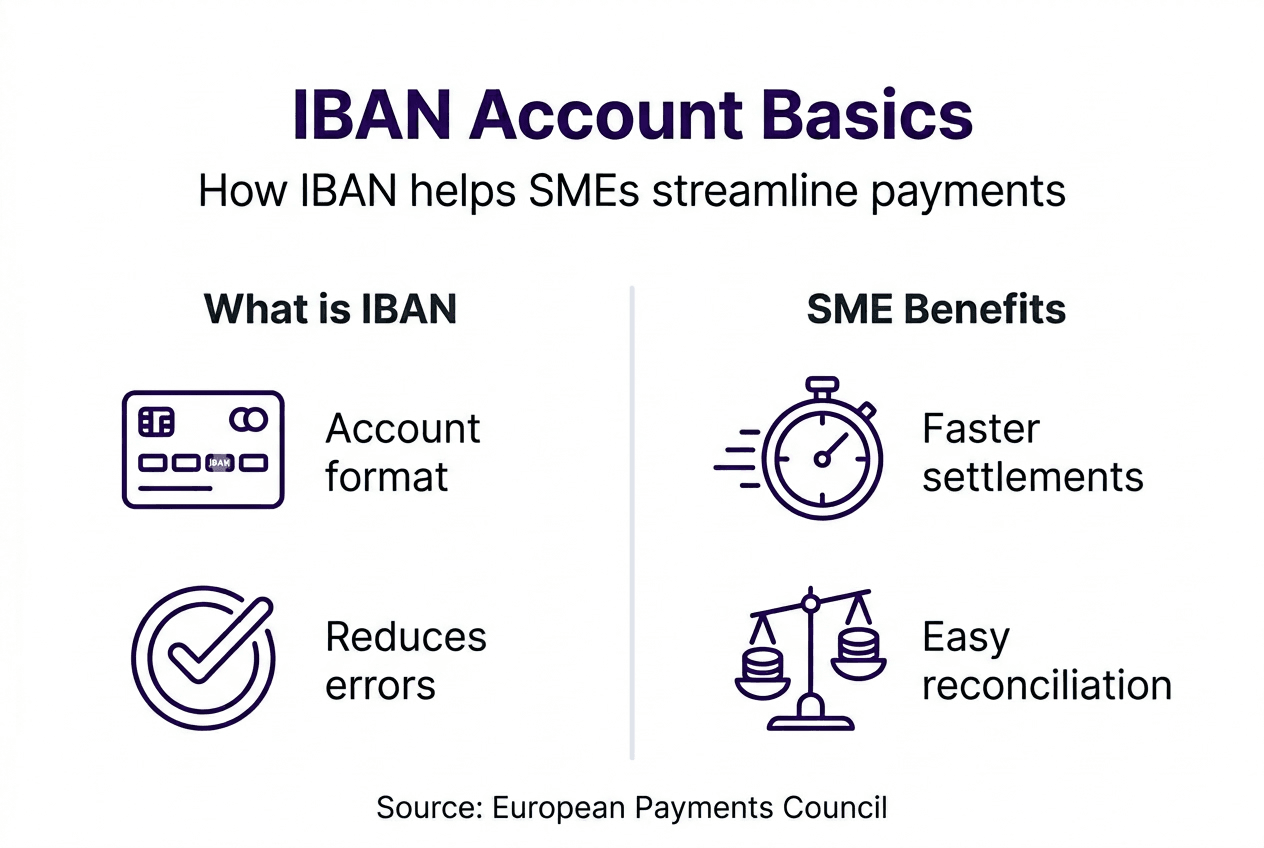
The IBAN is a standardized system developed by ISO and the ECBS to uniquely identify customer accounts in international transactions. This globally recognized format eliminates the confusion that once plagued cross-border payments when different countries used incompatible account numbering systems. For SMEs managing suppliers across multiple European countries, this standardization is transformative.
The IBAN consists of three core components working together:
- A two-letter country code identifying where the account is held
- Two check digits enabling error detection through mathematical validation
- The Basic Bank Account Number (BBAN) containing up to 30 characters of bank and account details
This structure reduces errors dramatically by providing a consistent format that payment systems can validate automatically before processing. When you send funds internationally, the receiving bank can instantly verify the account exists and belongs to the correct institution. This speeds reconciliation and minimizes failed transactions that waste time and money.
For business owners and financial managers in Europe, understanding the role of SEPA and IBAN becomes essential as international operations expand. The IBAN system ensures your payments reach the right destination whether you're paying a supplier in Germany, receiving funds from a client in France, or managing payroll across multiple countries. This reliability builds trust with international partners and reduces the administrative burden of tracking down missing payments.
The structure and validation of IBANs: How to ensure accuracy
Every IBAN begins with a two-letter country code followed by two check digits, then the BBAN specific to that country's banking system. IBAN lengths vary by country from 15 to 34 characters, with Norway using the shortest format at 15 characters and Malta requiring the longest at 34 characters. This variation reflects different national banking infrastructures, but the standardized prefix ensures universal compatibility.

| Country | IBAN Length | Example Format |
|---|---|---|
| Norway | 15 | NO9386011117947 |
| Germany | 22 | DE89370400440532013000 |
| United Kingdom | 22 | GB29NWBK60161331926819 |
| France | 27 | FR1420041010050500013M02606 |
| Malta | 34 | MT98VALL22013000000040012345678923 |
Validation happens through multiple layers of checks that catch errors before money moves. The process includes format verification to ensure correct length and character types, structure validation confirming the BBAN follows country-specific rules, and bank code lookups verifying the institution exists. The most powerful tool is the MOD-97 algorithm applied to the check digits, which catches nearly all single-character errors and transposition mistakes where two digits are accidentally swapped.
Here's how validation protects your transactions:
- Format checks confirm the IBAN matches the expected length and includes only valid characters
- The MOD-97 algorithm performs mathematical verification on check digits to detect data entry errors
- Structure validation ensures the BBAN portion follows country-specific formatting rules
- Bank code verification confirms the financial institution identifier is legitimate and active
Pro Tip: Always validate IBANs using automated tools before initiating payments, especially when entering account details manually. A single typo can send thousands of euros to the wrong destination or cause payment failures that delay critical transactions. Most modern international business bank account solutions include built-in IBAN validation to prevent these costly mistakes.
Understanding virtual IBANs (vIBANs) and their benefits for SMEs
Virtual IBANs represent an evolution in banking technology that solves a common SME problem: how to receive payments in multiple currencies without the complexity of maintaining separate physical accounts in each country. vIBANs provide a solution for businesses to receive payments without multiple physical accounts, offering unique IBANs that all map to a single underlying master account. This architecture gives your international customers local banking details they recognize and trust, while you manage everything from one centralized account.
The practical benefits for SMEs are substantial. When a German client sees a German IBAN on your invoice, they avoid international wire fees and process the payment as a domestic transaction. Meanwhile, those funds flow into your master account automatically, often converting to your preferred currency in the process. You eliminate the administrative burden of monitoring multiple bank accounts, reconciling statements across different institutions, and managing currency conversions manually.
Key advantages of vIBANs include:
- Receiving local payments without establishing legal entities or physical accounts in each country
- Reducing international wire fees that customers otherwise pass back to you through delayed payments
- Simplifying reconciliation by consolidating all incoming payments into a single account view
- Improving customer experience with familiar local banking details that increase payment completion rates
- Scaling internationally without proportional increases in banking complexity or costs
Pro Tip: Assign dedicated virtual IBANs for SMEs to different customer segments or revenue streams. This segregation makes tracking performance by market or product line effortless, as each vIBAN creates a natural divider in your payment data without requiring manual categorization.
Challenges of cross-border payments and how IBAN usage helps overcome them
Despite decades of financial innovation, international payments remain frustratingly complex for many SMEs. Common pain points include costly foreign exchange spreads that reduce your actual receipts, slow settlement times stretching three to five business days, customer hesitation when facing unfamiliar international payment procedures, and reconciliation headaches when payments arrive with incomplete reference data. These friction points compound as your business scales internationally, turning what should be simple transactions into administrative marathons.
IBANs address several of these challenges directly. The standardized format reduces data entry errors that cause payment failures and delays. Automated validation catches mistakes before funds leave the sender's account, eliminating the costly process of tracking down and returning misdirected payments. When combined with SEPA infrastructure, IBANs enable faster settlement compared to traditional correspondent banking networks that route payments through multiple intermediaries.
Real-world impact shows the power of modern payment orchestration. A top payments company reduced settlement time by 90% using advanced orchestration technologies that leverage IBANs and direct banking connections. For an SME, this translates to receiving funds in hours rather than days, improving cash flow predictability and reducing the working capital you need to maintain as a buffer against payment delays.
| Payment Method | Typical Settlement Time | Average Cost |
|---|---|---|
| Traditional wire transfer | 3-5 business days | €25-50 per transaction |
| SEPA with IBAN | Same or next business day | €0.20-2 per transaction |
| vIBAN local collection | Same day | €0.50-3 per transaction |
| Non-IBAN international | 5-7 business days | €40-75 per transaction |
Yet obstacles remain. Fragmented compliance requirements across jurisdictions create last-mile problems even when payment rails function smoothly. Regulators increasingly demand richer transaction data for anti-money laundering and sanctions screening, adding complexity for businesses unfamiliar with these requirements. The solution lies in streamlining business banking with SEPA and IBAN through platforms that handle compliance automatically while you focus on core business activities.
Cross-border payments remain costly, slow, and opaque, with high hidden fees and complex compliance requirements creating barriers for SMEs seeking to expand internationally. Understanding and leveraging IBAN infrastructure helps overcome many of these traditional obstacles.
The path forward combines technical standards like IBANs with modern banking platforms that abstract away complexity. As a business owner, you shouldn't need to become a payments expert to receive funds from international customers. The right tools make IBAN management invisible, delivering faster settlements and lower costs without requiring you to understand every technical detail.
Optimize your business banking with Bankz solutions
Transforming IBAN knowledge into operational advantage requires the right banking partner. Bankz offers multi-currency business accounts specifically designed for SMEs managing international transactions, combining efficient IBAN management with the flexibility modern businesses demand. Our platform reduces cross-border payment friction by providing access to multiple currencies and virtual IBAN capabilities within a single, unified dashboard.
When you streamline your business banking operations through Bankz, you gain more than just accounts. Business debit Visa cards integrate seamlessly with your multi-currency accounts, enabling spending in local currencies without conversion fees eating into your margins. Online banking platforms provide real-time visibility into all transactions, simplifying reconciliation and financial planning.
The benefits of international business bank accounts extend beyond basic functionality. High approval rates mean you can establish banking relationships quickly, even if you operate in sectors traditional banks consider high-risk. Ongoing support ensures you're never struggling alone with complex international payment scenarios. Whether you're expanding into new European markets or optimizing existing cross-border operations, international business bank account solutions from Bankz provide the infrastructure you need to scale confidently.
Frequently asked questions
What is the difference between an IBAN and a SWIFT code?
An IBAN identifies individual bank accounts internationally, enabling direct routing of payments to specific account holders. A SWIFT code identifies banking institutions globally, facilitating communication between banks for payment instructions. You typically need both for international wire transfers: the SWIFT code routes the payment to the correct bank, while the IBAN directs it to the specific account within that institution.
Can IBAN validation confirm the account owner?
IBAN validation confirms the IBAN's validity but does not guarantee ownership. The validation process checks format correctness, length, and checksum accuracy using the MOD-97 algorithm. However, it cannot verify that the account belongs to your intended recipient. Always confirm account ownership through separate verification channels before sending large payments, especially for new business relationships.
How do virtual IBANs impact payment reconciliation?
vIBANs allow funds to settle into a master account while segregating transaction streams, dramatically simplifying reconciliation. By assigning unique IBANs per customer, product line, or market, you create natural dividers in your payment data without manual categorization. When funds arrive, you instantly know the source and purpose because the receiving IBAN itself carries that information. This automation reduces reconciliation time from hours to minutes, eliminating the tedious process of matching incoming payments to invoices manually.
Are IBANs used outside Europe?
While IBANs originated in Europe and are mandatory for SEPA transactions, over 80 countries worldwide now use the IBAN system. Adoption includes Middle Eastern nations, many African countries, and some Central Asian states. However, major economies like the United States, Canada, Australia, and China do not use IBANs domestically. For payments to these countries, you'll rely on traditional account numbers combined with SWIFT codes or local routing systems.
What happens if I use an incorrect IBAN?
Using an incorrect IBAN typically results in payment rejection before funds leave your account, thanks to validation checks at your bank. If the error creates a valid but wrong IBAN that passes initial validation, the payment may be delivered to an unintended recipient. Recovering misdirected funds requires cooperation from the receiving bank and account holder, often involving fees and significant delays. This is why pre-transaction validation through automated tools is essential for protecting your business from costly mistakes.