

Think opening a European bank account remotely as a non-EU business is impossible? That's a myth fintech platforms have shattered with over 85% approval rates on remote setups. European banking delivers fast, compliant, and cost-efficient solutions for cross-border SME operations. This guide unpacks the regulatory, operational, and technological advantages plus practical steps to access European banking from anywhere in 2026.
Table of Contents
- Introduction To European Banking For Non-EU Businesses
- Benefits Of European Banking For Cross-Border Transactions
- Regulatory Compliance Advantages For Non-EU SMEs
- Multi-Currency Management And Account Flexibility
- Banking Solutions For High-Risk And Non-Conventional Businesses
- Common Misconceptions About European Banking For Non-EU Businesses
- How To Open And Manage European Bank Accounts Remotely
- Conclusion: Leveraging European Banking For Business Growth
- Discover Streamlined European Banking With Bankz
- Frequently Asked Questions About European Banking For Non-EU Businesses
Key takeaways
| Point | Details |
|---|---|
| Cost savings | SEPA payments and multi-currency accounts reduce transaction fees and foreign exchange costs significantly. |
| Remote access | Fintech platforms enable 85%+ approval rates for non-EU SMEs opening European accounts remotely. |
| Compliance ease | Automated AML and KYC tools simplify regulatory requirements while enhancing business credibility. |
| Multi-currency flexibility | Hold and convert 35+ currencies with multiple IBANs for efficient international cash flow management. |
| High-risk support | Specialized fintech partnerships improve access for non-conventional and high-risk business sectors. |
Introduction to European banking for non-EU businesses
Non-EU SMEs increasingly turn to European banking to unlock seamless access to regional financial infrastructure and global markets. The European banking ecosystem centers on SEPA, the Single Euro Payments Area, which enables streamlined euro payments across 36 countries with minimal friction. This network transforms how international businesses handle transactions.
Fintech innovation has revolutionized account access. Traditional barriers like physical presence requirements have dissolved. Digital platforms now offer remote onboarding, automated compliance checks, and integrated payment systems that traditional banks struggle to match. These technological leaps make European banking accessible to SMEs operating from anywhere.
The regulatory landscape adds another layer of appeal. European banking operates under strict frameworks that balance security with business flexibility. For non-EU companies managing cross-border operations, this environment provides:
- Transparent regulatory standards that reduce legal uncertainty
- Enhanced data protection under GDPR compliance
- Standardized payment protocols through SEPA and SWIFT networks
- Access to euro-denominated accounts without establishing physical entities
Demand for these services continues climbing as businesses recognize the operational advantages. SMEs handling international clients, vendors, or employees find European banking eliminates payment delays and cuts costs associated with currency conversion and wire transfers.
Benefits of European banking for cross-border transactions
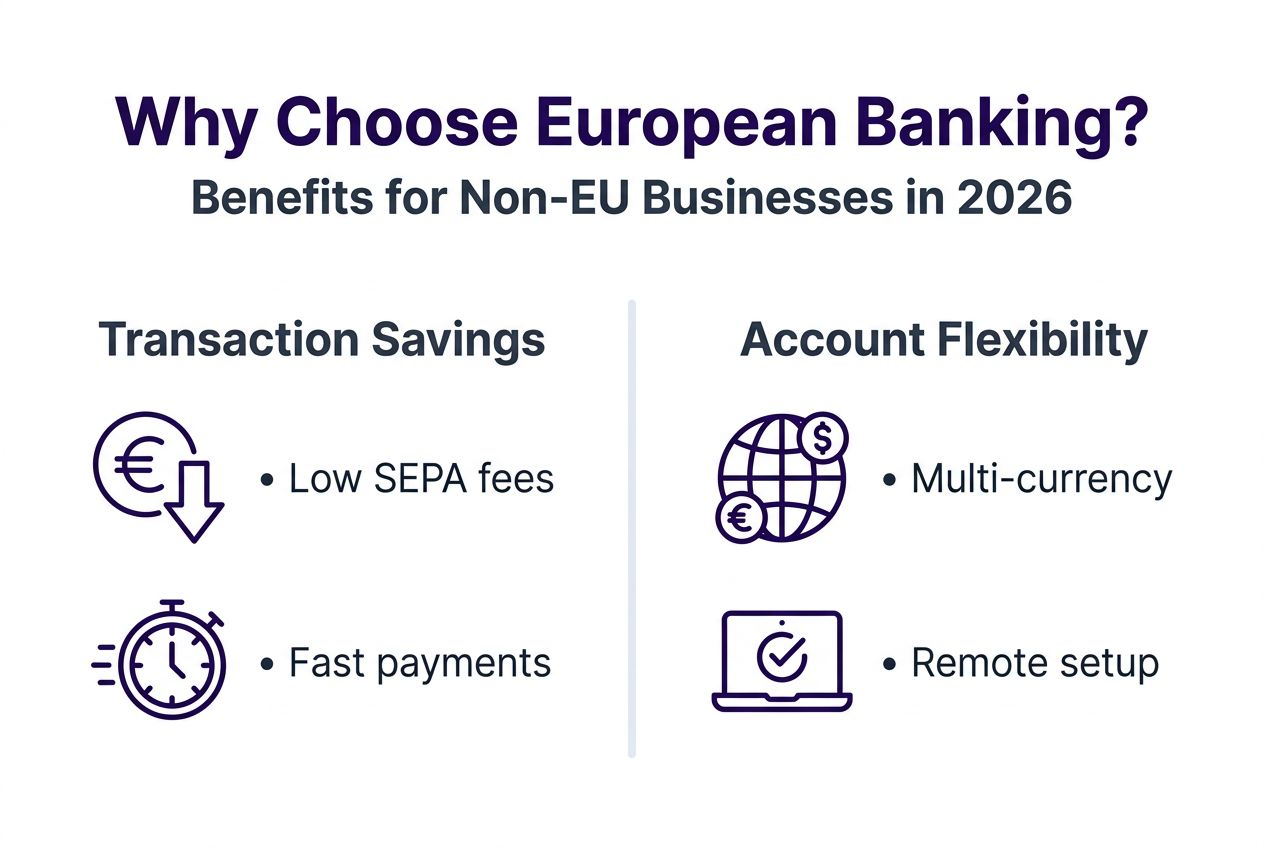
SEPA enables fast, low-cost euro payments across 36 countries, typically clearing within one business day. Transaction fees often stay under €0.50 per payment, dramatically lower than traditional international wire transfers. This efficiency transforms cash flow management for businesses dealing with European customers or suppliers.
Multi-currency accounts deliver another crucial advantage. Hold over 35 currencies simultaneously without opening separate accounts in each region. Convert funds at competitive rates when market conditions favor your business. This flexibility slashes hidden foreign exchange charges that traditional banks bury in conversion spreads.
Pro Tip: Compare your current FX conversion rates against mid-market rates. Most traditional banks add 2-4% markups on currency exchanges, while fintech platforms often charge under 1%, saving thousands annually on international transactions.
Consider this fee comparison between European banking and US traditional banks:
| Feature | European Banking (SEPA) | US Traditional Banks |
|---|---|---|
| International wire fee | €0.20-€0.50 | $35-$50 |
| Currency conversion markup | 0.5-1.2% | 2-4% |
| Account maintenance | Often €0-€15/month | $25-$50/month |
| Transaction clearance | 1 business day | 3-5 business days |
The speed advantage matters beyond convenience. Faster payment processing improves working capital cycles. Vendors receive payments quicker, strengthening supplier relationships. Clients appreciate modern payment options. The operational benefits compound across your entire business ecosystem.
International business banking solutions built on European infrastructure provide unified dashboards for managing payments across regions. Track euro, pound, and dollar transactions from one interface instead of juggling multiple banking portals. This consolidation reduces administrative overhead while improving financial visibility.
The SEPA and IBAN framework standardizes account identifiers and payment routing. IBANs eliminate confusion around international account numbers. SEPA ensures consistent processing across member countries. These standards reduce payment errors and failed transactions that cost businesses time and money.
Regulatory compliance advantages for non-EU SMEs
European banks enhance compliance with the EU Anti-Money Laundering Directive, reducing regulatory risks for non-EU businesses operating internationally. This framework protects your business from inadvertent violations while building credibility with partners and clients who value regulatory rigor.
Fintech platforms automate compliance workflows that traditionally required dedicated staff. Automated Know Your Customer (KYC) verification, transaction monitoring, and reporting tools handle regulatory requirements in the background. This automation delivers several benefits:
- Real-time transaction screening against sanctions lists
- Automatic flagging of unusual payment patterns
- Digital document collection and verification
- Continuous compliance monitoring without manual oversight
Pro Tip: Maintain organized digital copies of incorporation documents, beneficial ownership records, and business licenses. Having these files ready accelerates account opening and avoids delays during compliance reviews.
Regulated European banking institutions undergo rigorous oversight. Partnering with these banks enhances your business credibility when dealing with larger corporations, government entities, or risk-averse clients. The association signals financial legitimacy and operational maturity.

Risk mitigation extends beyond reputation. European banks implement robust fraud prevention systems and transaction security protocols. Multi-factor authentication, encryption standards, and suspicious activity monitoring protect business funds. These safeguards reduce exposure to financial crime that can devastate SME operations.
SME account verification processes have improved dramatically through fintech innovation. What once took weeks of back-and-forth documentation now completes in days. Digital verification tools cross-reference business registries, beneficial ownership databases, and compliance watchlists automatically.
For businesses in sectors traditional banks consider risky, specialized banking solutions provide compliant pathways others close off. European fintech platforms leverage technology and regulatory frameworks to serve industries like e-commerce, consulting, and digital services that face higher scrutiny elsewhere.
Multi-currency management and account flexibility
Multi-currency accounts supporting 35+ currencies revolutionize international financial management. Hold euros, US dollars, British pounds, and other major currencies in one account. Convert between currencies when rates favor your business instead of when transactions force conversions. This control reduces foreign exchange losses that erode profit margins.
Multiple IBANs per account provide organizational benefits beyond currency flexibility. Segregate funds by purpose, client, or region using distinct IBANs linked to your main account. This structure improves cash flow tracking and simplifies accounting across different business lines or geographic markets.
Consider these multi-IBAN usage scenarios versus single-IBAN limitations:
| Scenario | Multi-IBAN Benefits | Single-IBAN Limitations |
|---|---|---|
| Regional operations | Separate IBANs for EU, UK, and US clients | All payments mix in one account |
| Expense management | Dedicated IBANs for vendors vs. clients | Manual categorization required |
| Cash flow tracking | Real-time visibility by business line | Requires extensive reconciliation |
| Client invoicing | Professional local IBANs per market | Generic IBAN for all regions |
Fintech platforms deliver technological tools that maximize multi-currency and multi-IBAN capabilities:
- Automated currency conversion at preset exchange rate targets
- Real-time expense tracking across currencies and accounts
- Scheduled international payments with automatic currency selection
- Mobile apps for instant payment approvals and account monitoring
- API integrations connecting banking with accounting software
- Batch payment processing for vendor and payroll disbursements
These features transform banking from administrative burden into strategic asset. Business account setup optimized for multi-currency operations cuts FX costs by 40-60% compared to traditional banking arrangements.
The advantages of multi-currency accounts extend beyond cost savings. Competitive advantage emerges when you offer clients payment options in their preferred currencies. Customer satisfaction improves when European clients pay in euros, UK clients in pounds, without currency conversion hassles on their end.
Banking solutions for high-risk and non-conventional businesses
Specialized fintech partnerships focus on improving access and compliance frameworks for SMEs in sectors traditional banks avoid. These platforms combine regulatory expertise with technology to serve businesses traditional institutions reject outright. The results show in dramatically improved approval rates.
Fintech solutions reduce account rejection rates by over 20% for businesses in high-risk categories. Enhanced due diligence processes, continuous transaction monitoring, and transparent risk management frameworks satisfy regulators while serving legitimate businesses. This approach recognizes that industry classification shouldn't automatically disqualify compliant operators.
Compliance automation features tailored for non-conventional sectors address specific regulatory concerns. Transaction limits, enhanced reporting, and specialized monitoring protocols demonstrate responsible risk management to banking partners and regulators. These safeguards enable access rather than blocking it.
Key sectors benefiting from tailored European banking solutions include:
- Cryptocurrency and blockchain businesses requiring compliant fiat gateways
- E-commerce merchants processing high transaction volumes across borders
- Consulting and professional services with international client bases
- Digital marketing agencies managing client funds and ad spend
- Software and SaaS companies with global subscription models
- Online education and content platforms with diverse revenue streams
Banking for high-risk businesses leverages European regulatory frameworks that balance innovation with oversight. Unlike jurisdictions that ban entire industries, European approaches assess individual business models and implement appropriate controls.
Online banking platforms designed for high-risk SMEs provide specialized support teams familiar with industry challenges. These advisors understand regulatory nuances affecting your sector. They guide documentation requirements and help structure operations to maximize banking access while maintaining compliance.
The combination of technology and expertise creates viable pathways where traditional banking sees only roadblocks. European fintech proves that risk management and business access aren't mutually exclusive when approached thoughtfully.
Common misconceptions about European banking for non-EU businesses
Myth and reality diverge sharply around European banking accessibility. Clearing these misconceptions opens opportunities many businesses overlook based on outdated assumptions.
-
Myth: Remote account opening is impossible for non-EU businesses. Reality: Fintech platforms achieve 85%+ approval rates for remote applications. Digital verification, video KYC, and automated compliance checks eliminate physical presence requirements. Businesses from North America, Asia, and other regions successfully open European accounts without visiting Europe.
-
Myth: Only low-risk or EU-based businesses qualify for accounts. Reality: Specialized services support non-EU SMEs across risk profiles. High-risk sectors, startups without extensive operating history, and non-conventional business models access European banking through fintech platforms designed for their needs. Geographic location and industry classification create hurdles, not barriers.
-
Myth: Fees and compliance are prohibitively costly and complex for small businesses. Reality: SEPA reduces per-transaction costs to under €1 in most cases. Automation handles compliance workflows without requiring legal teams or dedicated staff. Monthly account fees often run €15 or less, sometimes zero. The total cost of European banking typically undercuts traditional international banking arrangements significantly.
-
Myth: Language barriers and unfamiliar regulations make European banking impractical. Reality: English-language support is standard across fintech platforms. Customer service teams operate in multiple languages. Regulatory frameworks, while rigorous, operate through standardized processes platforms navigate for you. Documentation requirements align with international norms most businesses already meet.
Fintech-enabled platforms report 85% approval rates on remote European business account applications in 2026, demolishing the myth that non-EU SMEs cannot access these banking services efficiently.
These misconceptions persist because traditional European banks historically did make access difficult. Physical presence requirements, relationship banking expectations, and manual compliance processes created real barriers. Fintech disruption changed everything. Digital-first platforms built for remote access transformed European banking from exclusive to accessible.
How to open and manage European bank accounts remotely
Navigating remote account opening requires systematic preparation but delivers streamlined results when approached correctly.
-
Identify your currency and banking needs. List currencies you regularly transact in, payment methods you need (SEPA, SWIFT, local transfers), and features like multi-IBAN support or debit cards. This assessment guides platform selection and account configuration.
-
Choose a fintech platform offering remote onboarding and compliance support. Research platforms serving your business type and industry. Compare fee structures, supported currencies, integration capabilities, and customer support quality. Verify regulatory licensing and banking partnerships.
-
Prepare and submit necessary KYC and AML documents digitally. Gather incorporation documents, beneficial ownership declarations, proof of business address, and director identification. Scan documents in high resolution. Most platforms accept uploads through secure portals.
-
Complete digital onboarding with video verification if needed. Some platforms require brief video calls to verify identity and business legitimacy. These typically take 10-15 minutes. Schedule during business hours in your platform's primary operating timezone for fastest processing.
-
Use fintech tools to integrate banking with your payment and cash management workflows. Connect your new European account to accounting software, payment processors, and invoicing systems. Set up automated payment rules, currency conversion triggers, and expense categorization.
-
Continuously monitor compliance and transactions using provided dashboards. Review transaction reports monthly. Keep business documentation current. Update beneficial ownership information when changes occur. Respond promptly to platform requests for additional information.
Pro Tip: Maintain a digital compliance folder with updated copies of all business documents, beneficial ownership records, and operational details. When platforms request information during periodic reviews, instant responses prevent account disruptions and demonstrate professional operation.
Account setup checklists help organize documentation and accelerate approval. Following structured processes reduces errors that delay onboarding. The investment in proper preparation pays dividends through smoother ongoing operations.
Streamlining business banking operations through European fintech platforms creates competitive advantages beyond cost savings. Faster payments improve vendor relationships. Multi-currency flexibility expands market opportunities. Professional banking infrastructure enhances credibility with larger clients.
Conclusion: leveraging European banking for business growth
European banking reduces costs, accelerates transactions, and strengthens compliance for non-EU SMEs pursuing international growth. SEPA infrastructure, multi-currency accounts, and automated regulatory tools deliver operational advantages traditional banking cannot match. These capabilities level the playing field between small businesses and larger competitors with dedicated treasury departments.
Fintech innovations ensure access regardless of physical location or industry risk profile. Remote onboarding, digital compliance, and specialized sector support overcome barriers that previously limited European banking to established companies with European operations. The democratization of access creates opportunities for agile SMEs to compete globally.
Strategic banking decisions unlock scalability and credibility in European markets. Offering local payment options, maintaining professional European banking relationships, and demonstrating regulatory compliance position businesses for partnerships and contracts that require financial sophistication. The right banking infrastructure becomes growth enabler rather than administrative necessity.
Discover streamlined European banking with Bankz
Transitioning from understanding benefits to implementing solutions requires the right partner. Bankz delivers multi-currency accounts, business debit cards, and compliance tools designed specifically for non-EU SMEs navigating cross-border banking complexity.
Streamline your business banking operations through an integrated platform managing 35+ currencies from one dashboard. Multiple IBANs organize cash flow across regions and business lines. SEPA, SWIFT, and local payment options ensure you can pay anyone, anywhere, efficiently.
Business debit Visa cards (physical and virtual) provide flexible spending controls for team members and online transactions. Set limits, track expenses in real time, and integrate card spending with accounting systems automatically.
Compliance and account management automation handles regulatory requirements without expanding your administrative team. KYC verification, transaction monitoring, and reporting happen seamlessly in the background. Focus on growing your business while Bankz manages banking complexity.
Key Bankz platform advantages include:
- 85%+ approval rates for remote business account applications
- Same-day account setup for qualifying businesses
- Multi-currency holdings with competitive FX rates
- Integrated expense management and payment automation
- Dedicated support for high-risk and non-conventional sectors
International bank account solutions through Bankz transform European banking from concept to competitive advantage. The platform proves that sophisticated banking infrastructure is accessible to SMEs ready to compete internationally.
"Bankz helped us reduce international payment costs by 60% while improving transaction speed. The multi-currency accounts and compliance automation let our small team operate like a much larger organization."
Frequently asked questions about European banking for non-EU businesses
Can non-EU businesses open European bank accounts remotely?
Yes, absolutely. Fintech platforms enable non-EU businesses to open European accounts completely remotely with 85%+ approval rates. Digital verification, automated compliance checks, and video KYC eliminate physical presence requirements. Businesses from anywhere can access European banking infrastructure without traveling to Europe.
Are European banking fees lower than other international banking options?
Typically yes, significantly lower. SEPA payments cost under €1 versus $35-$50 for traditional international wires. Multi-currency accounts reduce FX conversion markups from 2-4% to under 1%. Monthly maintenance fees often run €15 or less, compared to $25-$50 at traditional banks.
What documents are needed for compliance when opening European accounts?
Standard requirements include incorporation documents, beneficial ownership declarations, proof of business address, and director identification. Fintech platforms streamline collection through digital uploads and automated verification. Preparation takes hours, not weeks, when documents are organized properly.
Can high-risk businesses access European banking services?
Yes, through specialized fintech partnerships designed for higher-risk sectors. Platforms serving cryptocurrency, e-commerce, consulting, and digital businesses implement enhanced compliance frameworks that satisfy regulators while enabling account access. Industry classification creates additional scrutiny but not automatic rejection.
How do multi-currency accounts help my international business operations?
Multi-currency accounts let you hold 35+ currencies simultaneously, converting at favorable rates rather than when transactions force conversions. This reduces FX costs by 40-60% compared to traditional banking. You can invoice clients in their preferred currencies and pay vendors without constant conversion fees eating into margins.
How long does remote European account opening typically take?
Most fintech platforms complete account opening within 1-5 business days for straightforward applications. High-risk sectors or complex ownership structures may take 7-14 days. Speed depends on document completeness and compliance review requirements. Same-day approval is possible for well-prepared applications.