

Managing cross-border transactions shouldn't drain your startup's resources or delay critical payments. Yet many founders face exactly this problem, watching days slip by as international transfers crawl through outdated banking systems while fees eat into already tight margins. Modern digital banking processes offer a solution, combining multi-currency accounts, automated workflows, and AI-powered tools to transform how startups handle international financial operations. This guide walks you through practical steps to build an efficient digital banking framework that saves time, cuts costs, and scales with your business.
Table of Contents
- Understanding The Challenges In Digital Banking For Startups
- Preparing Your Startup For An Efficient Digital Banking Process
- Executing Seamless Digital Banking Transactions For Startups
- Verifying And Optimizing Your Digital Banking Workflows
- How Bankz Powers Your Startup's Digital Banking Journey
- FAQ
Key takeaways
| Point | Details |
|---|---|
| Transaction delays hurt cash flow | Cross-border payments often take days, disrupting project timelines and working capital |
| Multi-currency accounts reduce costs | Holding funds in native currencies eliminates unnecessary conversion fees |
| API automation streamlines operations | Integrated banking APIs enable automated reconciliation and payment processing |
| AI enhances security and efficiency | Machine learning tools detect fraud in real time while improving customer experience |
Understanding the challenges in digital banking for startups
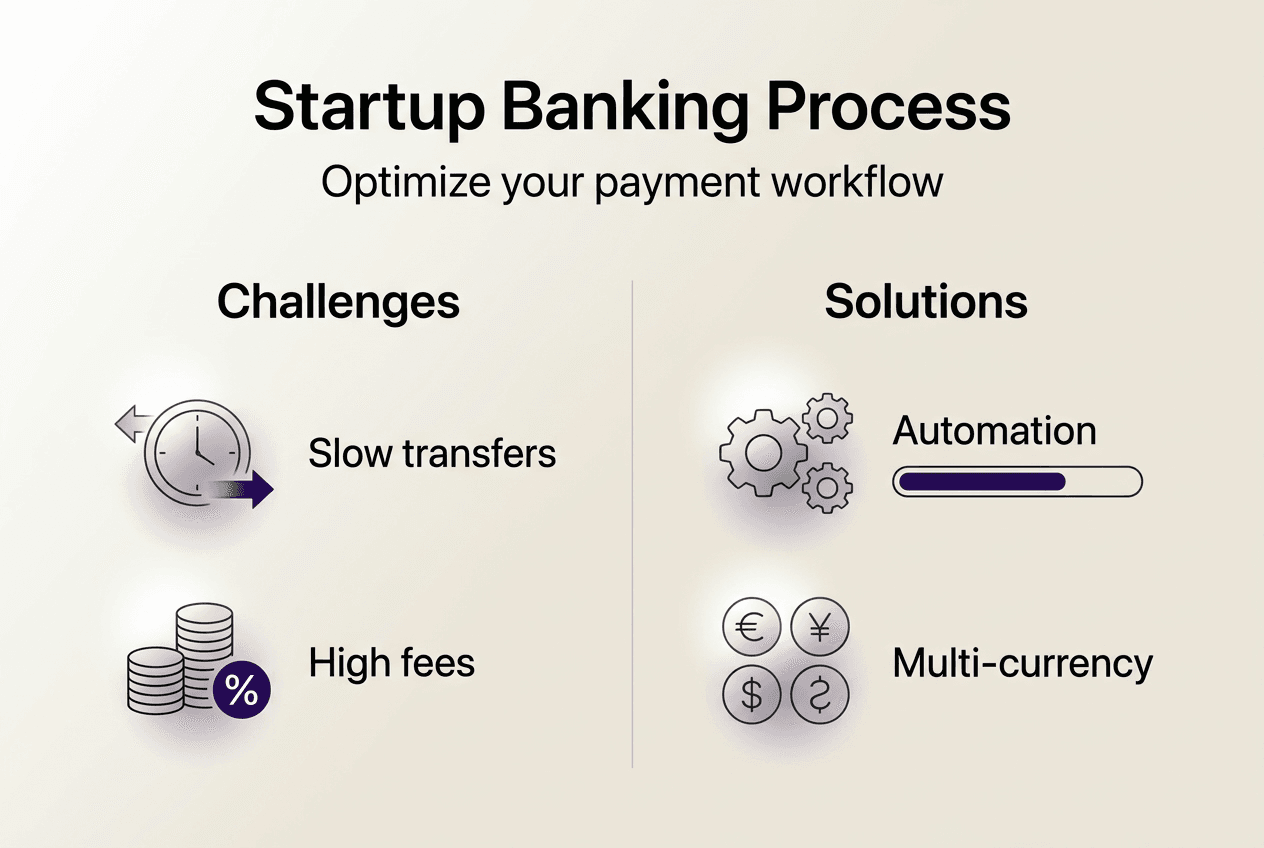
Startups operating internationally face a maze of banking obstacles that traditional financial institutions struggle to solve efficiently. Cross-border transactions often take days to settle and incur significantly higher costs than domestic transfers, creating immediate cash flow headaches. When you're waiting three to five business days for a payment to clear, you can't pay contractors on time, miss early payment discounts, or respond quickly to market opportunities.
High transaction fees compound these delays. Banks layer multiple charges onto international transfers, including conversion fees, correspondent bank fees, and receiving bank charges. A single payment might lose 3-5% of its value before reaching the destination account. For startups operating on thin margins, these costs directly impact profitability and growth potential.
Opaque routing creates another frustration. Money moves through multiple intermediary banks, each adding time and cost while providing zero visibility into the payment's status. You send funds on Monday and hope they arrive by Friday, with no way to track progress or explain delays to anxious suppliers. This uncertainty makes financial planning nearly impossible.
Building compliant payment platforms demands technical expertise most startups lack. You need to navigate varying regulations across jurisdictions, implement proper security protocols, and maintain audit trails that satisfy multiple regulatory bodies. The technical complexity grows exponentially when handling multiple currencies and payment methods simultaneously.
Startups also struggle with fragmented systems. You might use one provider for euro payments, another for pound transfers, and a third for currency exchange. Managing multiple platforms wastes time, creates reconciliation nightmares, and increases the risk of errors. Consider these common pain points:
- Settlement delays that disrupt supplier relationships and project schedules
- Hidden fees that erode profit margins on every transaction
- Limited visibility into payment status and routing
- Complex compliance requirements across different markets
- Disconnected tools that prevent efficient financial management
These challenges aren't just inconveniences. They represent real costs in time, money, and opportunity. A founder spending hours each week managing banking issues isn't building product or serving customers. Online banking solutions for startups address these problems by consolidating services and automating routine tasks, but choosing the right approach requires understanding your specific needs.
Preparing your startup for an efficient digital banking process
Before implementing new banking workflows, you need a clear picture of your requirements and constraints. Start by mapping your typical transaction patterns. How many international payments do you process monthly? Which currencies do you handle most frequently? What's your average transaction size? These answers shape which features matter most for your operation.
Identify essential banking capabilities for your business model. Multi-currency accounts let you hold and transact in multiple currencies without constant conversions. API integration enables automated payment processing and reconciliation, eliminating manual data entry. Virtual and physical debit cards provide flexible spending controls for team members. SEPA and SWIFT capabilities ensure you can reach any counterparty globally.

Compliance requirements vary dramatically by jurisdiction and business type. Research regulations in every market where you operate or have customers. Some countries require local banking relationships, while others accept international fintech providers. Understanding these rules upfront prevents costly mistakes and regulatory headaches later. Document your compliance checklist and update it as regulations evolve.
Fintech providers are expanding global payout networks, offering multi-currency accounts and APIs that integrate local and international rails. This infrastructure evolution means startups can access banking capabilities that were previously available only to large enterprises. Evaluate providers based on their network reach, integration options, and support for your specific use cases.
Create a detailed requirements document covering these elements:
- Transaction volume and frequency across different currencies
- Required payment methods (SEPA, SWIFT, local transfers)
- Integration needs with accounting and ERP systems
- Team access controls and approval workflows
- Reporting and reconciliation requirements
- Scalability to handle 3-5x growth in transaction volume
Pro Tip: Test your banking provider's customer support before committing. Send questions through their support channels and note response times and quality. When payment issues arise, fast, knowledgeable support becomes critical.
Consider total cost of ownership beyond headline fees. Compare these factors across providers:
| Cost Factor | Traditional Bank | Modern Fintech | Impact on Startups | | --- | --- | --- | | Monthly account fees | $50-200 | $0-50 | Lower fixed costs improve unit economics | | Cross-border transfer fees | 3-5% + fixed fee | 0.5-2% | Dramatic savings on international payments | | Currency conversion markup | 2-4% above mid-market | 0.3-1% | Reduces cost of multi-currency operations | | API access | Often unavailable | Included | Enables automation and integration |
Fintech accounts for SMEs deliver better economics specifically because they're built for digital-first operations. They eliminate legacy infrastructure costs and pass savings to customers through lower fees and better exchange rates.
Plan for scalability from day one. Your banking infrastructure should handle 10x growth without requiring a complete rebuild. Look for providers offering graduated pricing, unlimited users, and robust APIs that support high transaction volumes. The right foundation scales seamlessly as your startup grows.
Executing seamless digital banking transactions for startups
Once your banking infrastructure is ready, implement systematic workflows that maximize efficiency and minimize errors. Follow these steps to execute transactions smoothly:
-
Automate recurring payments through API integration. Connect your banking platform to accounting software so approved invoices trigger payments automatically. This eliminates manual payment entry, reduces errors, and ensures suppliers get paid on time without constant oversight.
-
Configure smart routing rules that optimize for speed and cost. Modern platforms can automatically select the fastest, cheapest route for each payment based on destination, currency, and amount. A euro payment to Germany goes through SEPA, while a dollar payment to the US uses the most efficient correspondent network.
-
Maintain multi-currency balances to avoid unnecessary conversions. When you regularly receive and send payments in specific currencies, hold working balances in those currencies. Convert only when exchange rates are favorable, not every time you make a payment.
-
Implement approval workflows that balance control with speed. Small payments might auto-approve, while larger amounts require manager review. Set thresholds that match your risk tolerance and team structure.
-
Enable real-time notifications for all transaction events. Immediate alerts when payments are sent, received, or encounter issues let you respond quickly to problems and keep stakeholders informed.
Pro Tip: Schedule currency conversions for early morning European time when forex markets typically offer better liquidity and tighter spreads, potentially saving 0.1-0.3% on large conversions.
Firms are actively investing in AI to enhance customer experience, improve operational efficiency and drive cost savings. Leverage these AI-powered capabilities in your banking operations:
- Fraud detection systems that flag suspicious transactions before they process
- Chatbots that answer routine banking questions instantly
- Predictive analytics that forecast cash flow and currency needs
- Automated reconciliation that matches payments to invoices without manual review
Monitor transaction statuses actively rather than waiting for problems to surface. Check your dashboard daily to verify expected payments arrived and identify any stuck transactions. Most issues resolve faster when caught early. Set up alerts for payments that exceed expected processing times.
Use virtual cards for online subscriptions and vendor payments. They provide better security than sharing your main account details, allow granular spending controls, and simplify expense tracking. Issue separate virtual cards for different services or team members, then deactivate them instantly if needed.
Compare execution approaches:
| Approach | Speed | Cost | Control | Best For | | --- | --- | --- | --- | | Manual processing | Slow | High labor cost | Maximum oversight | Low volume, high-value transactions | | Semi-automated | Moderate | Medium | Balanced | Growing startups transitioning systems | | Fully automated | Fast | Low | Rule-based | High volume, standardized payments |
Digital banking for cross-border success requires choosing the right balance of automation and control for your specific situation. Most startups benefit from semi-automated workflows initially, then increase automation as processes mature and transaction volumes grow.
Document standard operating procedures for common scenarios. How do you handle failed payments? What's the process for urgent transfers? Who approves payments above certain thresholds? Written procedures ensure consistency and make onboarding new team members easier.
Verifying and optimizing your digital banking workflows
Efficient banking processes require ongoing monitoring and refinement. Set up regular reviews to catch issues early and identify optimization opportunities. Weekly transaction reports should highlight any anomalies, unexpected fees, or processing delays that need investigation.
Verify compliance continuously rather than treating it as a one-time checkbox. Regulations evolve constantly, particularly in fintech and cross-border payments. Subscribe to regulatory updates for your key markets and review your processes quarterly to ensure ongoing compliance. Building compliant, scalable and user-friendly cross-border payment platforms remains technically demanding, requiring constant attention as your business and regulations change.
Analyze transaction data to identify patterns and bottlenecks. Which payment routes consistently take longer than expected? Where are you paying the highest fees? Are certain currencies causing recurring issues? Data-driven insights reveal specific areas for improvement rather than generic optimization efforts.
Solicit feedback from everyone who interacts with your banking systems. Your finance team knows which reconciliation tasks consume the most time. Sales teams can identify payment friction that costs deals. Contractors and suppliers can tell you how your payment speed and reliability compare to other clients. This qualitative feedback often uncovers problems that don't show up in transaction reports.
Implement these verification practices:
- Monthly reconciliation audits comparing bank records to accounting system
- Quarterly compliance reviews checking adherence to relevant regulations
- Bi-annual provider evaluations assessing whether your banking partner still meets needs
- Regular testing of backup procedures and alternative payment routes
- Continuous monitoring of exchange rates to optimize conversion timing
Track key performance indicators that matter for your banking operations. Average settlement time shows whether payments are processing efficiently. Total transaction costs as a percentage of payment volume reveals whether you're getting competitive rates. Failed transaction rate indicates system reliability and data quality. These metrics provide objective measures of banking performance over time.
Stay current with fintech innovations that could benefit your operations. New payment rails, improved APIs, and enhanced security features emerge regularly. What wasn't possible last year might be standard practice today. Attend fintech webinars, read industry publications, and maintain relationships with multiple providers to stay informed about new capabilities.
Test new features in controlled environments before full deployment. When your provider releases updated APIs or new payment methods, run parallel tests with small transaction volumes first. This approach catches integration issues and unexpected behavior before they impact critical payments.
Cash flow management strategies improve dramatically when you optimize banking workflows. Faster payments mean better working capital management. Lower fees improve margins. Automated reconciliation frees finance team time for strategic work. These benefits compound over time, making continuous optimization worthwhile.
Document lessons learned from payment issues and near-misses. When something goes wrong, conduct a brief post-mortem to understand root causes and prevent recurrence. Build this knowledge into updated procedures and system configurations. Organizations that learn from mistakes build more resilient operations.
How Bankz powers your startup's digital banking journey
Implementing the strategies in this guide becomes simpler with the right banking partner. Bankz provides startups with the exact capabilities needed for efficient international operations, combining multi-currency accounts, business debit Visa cards, and integrated payment processing in one platform. The service is specifically designed for businesses operating across borders, eliminating the complexity and high costs that plague traditional banking relationships.
Startups using Bankz benefit from streamlined SEPA and SWIFT transfers that minimize cross-border payment delays and fees. Multi-currency accounts and debit cards let you hold and transact in multiple currencies without constant conversions, directly addressing the cost challenges outlined earlier. The platform's focus on automation and API integration means you can implement the efficient workflows described in this guide without building complex technical infrastructure yourself.
International business bank account solutions from Bankz support high-risk and non-conventional businesses that traditional banks often reject, with high approval rates and ongoing support. Whether you need multiple IBANs for different business units, expense management tools for distributed teams, or streamlined international business banking capabilities, Bankz consolidates everything into a single dashboard. This unified approach transforms the fragmented banking experience most startups endure into a cohesive system that scales with your growth.
FAQ
What is the typical settlement time for cross-border transactions in digital banking?
Cross-border settlements through traditional banking often take three to five business days due to multiple intermediary banks and manual processing steps. Modern fintech solutions can reduce this to one to two business days or even same-day settlement for certain currency pairs and payment routes. Settlement speed varies significantly based on the currencies involved, payment method used (SEPA, SWIFT, or local rails), and whether the transaction requires currency conversion.
How do multi-currency accounts benefit startups operating internationally?
Multi-currency accounts enable you to receive, hold, and send payments in various currencies without converting funds each time. This eliminates costly conversion fees that can reach 3-5% per transaction and protects against unfavorable exchange rate timing. You can convert currencies strategically when rates are favorable rather than being forced to convert at every transaction. These accounts also simplify reconciliation by maintaining separate balances for each currency, making it easier to track revenue and expenses by market. For startups with recurring international transactions, online banking solutions for startups with multi-currency capabilities deliver immediate cost savings and operational efficiency.
What security measures ensure safe digital banking for startups?
Modern digital banking platforms employ AI-driven fraud detection systems that analyze transaction patterns in real time, flagging suspicious activity before payments process. End-to-end encryption protects data in transit and at rest, while multi-factor authentication prevents unauthorized account access. Compliance with international financial regulations like PSD2 in Europe and AML/KYC requirements globally ensures platforms maintain rigorous security standards. Additional protections include transaction limits, approval workflows for large payments, virtual cards that isolate spending exposure, and detailed audit logs that track every action. Regular security audits and penetration testing help identify vulnerabilities before bad actors can exploit them.
How can startups reduce cross-border payment costs effectively?
Reducing payment costs requires a multi-pronged approach starting with choosing a provider that offers transparent, competitive pricing without hidden fees. Maintain balances in currencies you frequently use to avoid unnecessary conversions. Batch smaller payments when possible to reduce per-transaction costs. Use the most efficient payment rail for each transaction, SEPA for euro zone transfers costs far less than SWIFT. Time currency conversions strategically rather than converting at market close or during low liquidity periods. Finally, negotiate volume discounts with your banking provider as transaction volumes grow, many fintech platforms offer better rates for high-volume customers.