

The travel industry experienced a 71% surge in chargebacks during the COVID-19 pandemic, exposing vulnerabilities that define high-risk business accounts. For entrepreneurs in sectors like travel, gaming, or subscription services, these elevated risks translate to banking roadblocks that can cripple operations. Understanding what makes an account high-risk and how to navigate the financial landscape is essential for building sustainable businesses in 2026. This guide breaks down the challenges, solutions, and strategies you need to thrive despite banking barriers.
Table of Contents
- Defining High-Risk Business Accounts And Why They Matter
- Challenges Faced By High-Risk Businesses In Banking And Finance
- How Multi-Currency And Cross-Border Banking Solutions Help High-Risk Businesses Thrive
- Comparing Banking Options For High-Risk Business Accounts In 2026
- Explore Bankz Solutions Tailored For High-Risk Businesses
- Frequently Asked Questions
Key takeaways
| Point | Details |
|---|---|
| High-risk classification | Banks use merchant category codes and risk factors like chargebacks to label businesses high-risk, limiting banking access. |
| Banking challenges | High-risk firms face account terminations, higher fees, reserve requirements, and difficulty securing payment processors. |
| Multi-currency solutions | Cross-border banking with multi-currency accounts reduces transaction flags and improves cash flow for global operations. |
| Strategic selection | Choosing specialized providers over traditional banks offers better approval rates and tailored services for high-risk needs. |
Defining high-risk business accounts and why they matter
A high-risk business account is a banking relationship that financial institutions categorize using merchant category codes to identify merchants more likely to face chargebacks, fraud, or regulatory scrutiny. Banks assess risk through multiple lenses: transaction volume, chargeback ratios, industry reputation, and compliance complexity. When your business falls into a high-risk category, you face stricter underwriting, higher processing fees, and potential account closures.
Several factors push businesses into high-risk territory. Chargeback rates above 1% signal potential fraud or customer dissatisfaction. Industries with historically high dispute rates, like nutraceuticals or adult entertainment, automatically trigger caution. Subscription models raise flags because recurring billing generates more payment disputes. Cross-border transactions increase complexity and regulatory exposure, making banks nervous about compliance violations.
Traditional banks hesitate to serve high-risk accounts because they prioritize stability over profit potential. A single merchant account generating excessive chargebacks can damage a bank's relationship with card networks like Visa or Mastercard. The regulatory burden of monitoring high-risk clients for money laundering or fraud consumes resources that banks would rather allocate elsewhere. Reserve requirements, where banks hold a percentage of your revenue as protection, tie up capital and create cash flow problems.
Common high-risk industries include:
- Travel and tourism services
- Online gaming and gambling platforms
- Cryptocurrency exchanges and wallet providers
- Subscription box services and continuity programs
- CBD and hemp product retailers
- Debt collection and credit repair agencies
Understanding your risk profile helps you approach banking strategically. If you operate in a flagged sector, anticipate higher costs and prepare documentation proving your business model's legitimacy. Online business banking for high-risk businesses offers alternatives when traditional institutions decline your application. The key is recognizing that high-risk status isn't a permanent barrier but a challenge requiring specialized solutions.
Challenges faced by high-risk businesses in banking and finance
High-risk businesses encounter financial losses, regulatory violations, and reputational damage that make traditional payment processors and banks reluctant partners. Chargebacks represent the most immediate threat. When customers dispute charges, you lose the sale revenue plus incur fees ranging from $20 to $100 per incident. Excessive chargebacks can trigger account termination, leaving you scrambling for alternatives mid-operation.
Regulatory compliance creates a constant burden. You must demonstrate adherence to anti-money laundering rules, know-your-customer protocols, and industry-specific regulations. Payment Card Industry Data Security Standards require expensive infrastructure investments to protect cardholder data. Failure to maintain compliance results in fines, account freezes, or permanent blacklisting from payment networks. The administrative overhead of documenting compliance diverts resources from growth initiatives.
High-risk merchants need to show compliance with major oversight bodies and face increased chargeback risk potentially leading to account termination.
Reputational impacts compound operational difficulties. When banks label you high-risk, other financial institutions notice. You enter a cycle where each rejection makes the next application harder. Payment processors demand higher reserve percentages, sometimes holding 10% to 20% of monthly revenue for six months or longer. These reserves strangle cash flow, preventing you from investing in inventory, marketing, or hiring.

Account stability becomes unpredictable. Banks can freeze funds during investigations or terminate relationships with minimal notice. Imagine losing access to your operating capital during peak season because an algorithm flagged unusual transaction patterns. The uncertainty makes long-term planning nearly impossible and forces you to maintain backup banking relationships.
Specific challenges include:
- Processing fees 2x to 3x higher than standard merchant accounts
- Rolling reserves that lock up working capital for extended periods
- Limited access to business credit and financing options
- Difficulty integrating with popular e-commerce platforms
- Constant monitoring and reporting requirements
These obstacles explain why banking solutions for high-risk industries have emerged as essential tools. Specialized providers understand your challenges and build services around managing risk rather than avoiding it. The goal shifts from finding any bank to finding the right banking partner who views your business model as manageable rather than unacceptable.
How multi-currency and cross-border banking solutions help high-risk businesses thrive
Multi-currency accounts address a critical vulnerability for high-risk businesses: merchants processing many cross-border transactions raise flags that increase risk classification. When you accept payments in multiple currencies and convert everything to your home currency, each conversion creates a transaction record that banks scrutinize. Holding funds in native currencies reduces conversion frequency and the associated red flags.
Cross-border payment capabilities streamline international operations. Instead of routing transactions through multiple intermediaries, you can send and receive payments directly in local currencies. This reduces processing time from days to hours and cuts fees significantly. For businesses serving global markets, the ability to pay suppliers in euros, accept customer payments in pounds, and manage payroll in dollars from a single platform transforms operational efficiency.
Advanced banking solutions improve compliance management through automated reporting and real-time monitoring. You gain visibility into transaction patterns that might trigger alerts, allowing you to address issues proactively. Integrated compliance tools help you maintain documentation for audits and regulatory inquiries. This transparency builds trust with banking partners and reduces the likelihood of sudden account actions.
Key features to prioritize when selecting banking partners:
- Multiple IBAN accounts for holding various currencies without conversion
- SWIFT, SEPA, and local payment network access for flexible transfers
- Virtual and physical debit cards for expense management across teams
- Real-time dashboards showing transaction status and currency positions
- Dedicated support teams familiar with high-risk industry challenges
Pro Tip: Prioritize providers with proven experience serving your specific industry. A fintech that has successfully onboarded similar high-risk businesses understands the documentation requirements and can expedite approval. Generic providers often lack the risk appetite or expertise to evaluate your application fairly.
Multi-currency accounts and debit cards enable you to operate globally without constantly explaining your business model to skeptical bankers. The right solution treats cross-border complexity as a feature rather than a bug. International business banking benefits extend beyond convenience to strategic advantages like currency arbitrage opportunities and reduced foreign exchange exposure.
Comparing banking options for high-risk business accounts in 2026
Traditional banks, specialized high-risk providers, and online fintech platforms offer distinct advantages for managing high-risk business accounts. A high-risk designation reflects likelihood of financial losses, chargebacks, fraud, regulations, and business model factors, so choosing the right partner depends on your specific risk profile and operational needs.
| Provider Type | Approval Difficulty | Fee Structure | Service Scope | Best For |
|---|---|---|---|---|
| Traditional Banks | Very High | Standard rates if approved | Full banking suite | Established businesses with strong financials |
| Specialized High-Risk Processors | Moderate | Premium rates, high reserves | Payment processing focus | Businesses needing immediate merchant accounts |
| Online Fintech Platforms | Low to Moderate | Competitive with transparent pricing | Multi-currency, global payments | Cross-border businesses seeking flexibility |
Traditional banks provide comprehensive services but impose strict approval criteria. You need years of operating history, substantial revenue, and low chargeback ratios. Even if approved, expect intensive ongoing monitoring and limited flexibility for business model changes. The advantage lies in relationship banking: access to business loans, lines of credit, and integrated treasury services. However, the approval process takes weeks or months, making traditional banks impractical for startups or businesses pivoting into new markets.
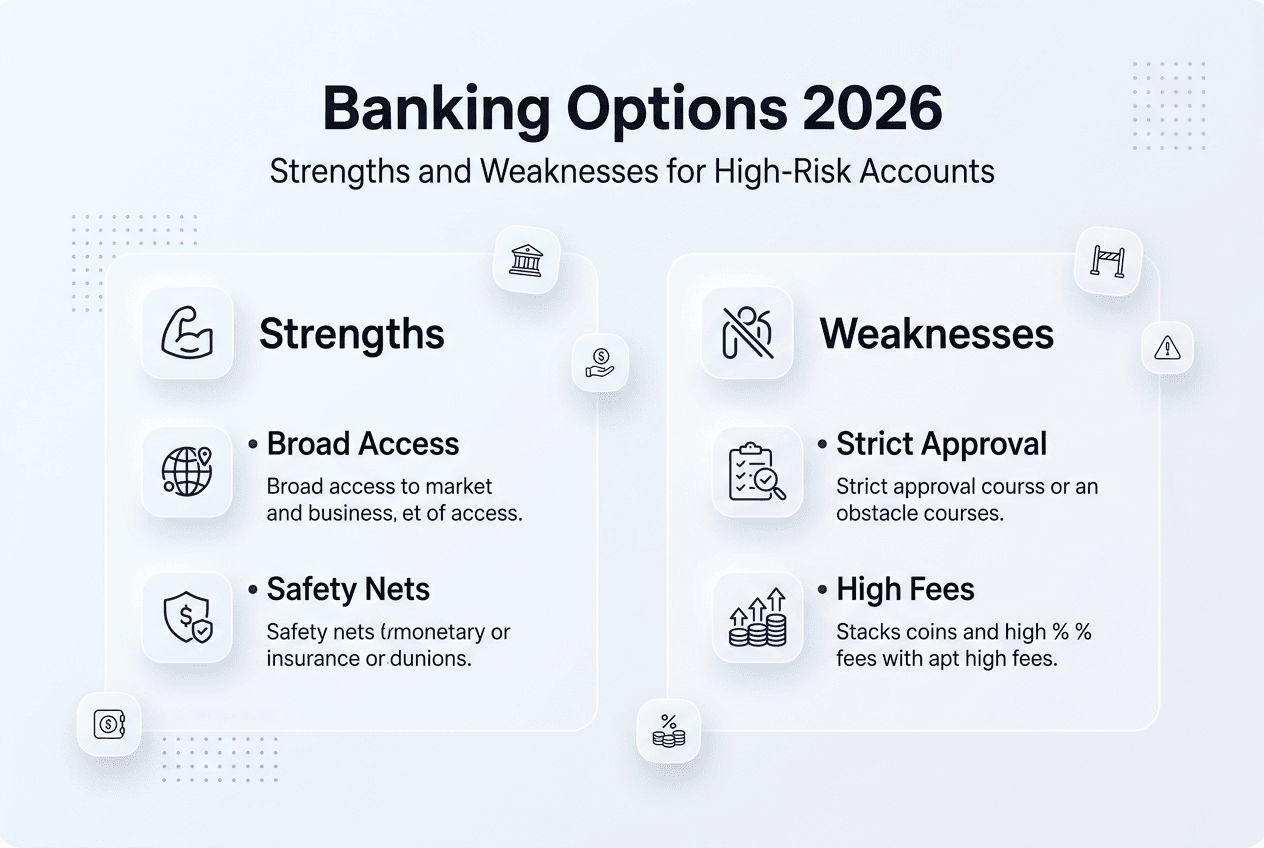
Specialized high-risk payment processors understand your industry but charge premium rates. Processing fees range from 3% to 8% per transaction, compared to 1.5% to 3% for standard merchants. Rolling reserves can reach 20% of monthly volume, held for six months or longer. These providers excel at maintaining relationships with card networks despite elevated chargeback rates. They offer faster approval than traditional banks and provide expertise in managing disputes and fraud prevention.
Online fintech platforms balance approval accessibility with competitive pricing. They leverage technology to assess risk dynamically rather than relying solely on industry classification. You gain access to multi-currency accounts, international payment rails, and expense management tools through unified dashboards. Approval timelines shrink to days rather than weeks. The trade-off is potentially limited access to traditional banking products like business loans, though many fintechs partner with lenders to fill this gap.
Critical evaluation criteria:
- Reserve policies and how quickly you can access held funds
- Geographic coverage and supported currencies for your markets
- Integration capabilities with your existing accounting and e-commerce systems
- Chargeback management tools and dispute resolution support
- Regulatory compliance assistance and audit preparation resources
Pro Tip: Evaluate how providers handle account reviews and potential terminations. Transparent policies about what triggers investigations and clear appeal processes indicate a partner who views you as a client rather than a liability. Ask about notice periods and fund access during disputes.
Most businesses miss the importance of scalability when selecting banking partners. A solution that works at $50,000 monthly revenue may become restrictive at $500,000. Bankz solutions for high-risk businesses offer growth-oriented infrastructure that adapts as your transaction volume and geographic reach expand. The right choice balances immediate needs with long-term strategic goals.
Explore Bankz solutions tailored for high-risk businesses
Navigating high-risk business banking requires partners who understand your challenges and build solutions around them. Bankz specializes in serving businesses that traditional banks decline, offering multi-currency accounts and business debit Visa cards designed for cross-border operations. Our platform provides multiple IBAN accounts, SWIFT and SEPA payment capabilities, and real-time expense management from a unified dashboard.
Whether you operate in travel, gaming, subscriptions, or other high-risk sectors, Bankz solutions for high-risk businesses streamline international transactions and reduce the friction of managing global finances. Our high approval rates and ongoing support help you focus on growth rather than banking obstacles. Explore how business debit Visa cards and integrated payment solutions can transform your financial operations in 2026.
Frequently asked questions
What makes a business high-risk for banks?
Banks classify businesses as high-risk based on industry type, chargeback history, transaction patterns, and regulatory complexity. Sectors like travel, gaming, CBD, and subscription services face automatic scrutiny due to historical fraud rates and dispute frequency. Cross-border transactions, recurring billing models, and high ticket values also elevate risk profiles. Financial institutions use merchant category codes to systematically identify businesses requiring enhanced monitoring.
How can high-risk businesses reduce chargeback risks?
Implement clear billing descriptors that customers recognize on statements to prevent confusion-based disputes. Provide detailed product descriptions, transparent refund policies, and responsive customer service to address issues before they escalate to chargebacks. Use fraud detection tools to screen transactions for suspicious patterns. Maintain thorough documentation of customer communications and delivery confirmations to contest illegitimate disputes effectively.
Are multi-currency accounts crucial for high-risk enterprises?
Multi-currency accounts significantly benefit high-risk businesses operating internationally by reducing transaction flags that banks monitor. Holding funds in native currencies eliminates constant conversions that create scrutiny-worthy transaction records. You gain flexibility to pay suppliers and accept customer payments in local currencies, improving cash flow and reducing foreign exchange costs. For cross-border operations, multi-currency capability transforms from nice-to-have to essential infrastructure.
What happens if a high-risk business loses its bank account?
Losing your bank account triggers immediate operational crisis. You cannot process payments, pay suppliers, or manage payroll until you secure alternative banking. Funds may be frozen during investigations, creating cash flow emergencies. The termination appears on your banking history, making future applications harder. You must quickly identify backup providers, which is why maintaining relationships with multiple banking partners is critical risk management for high-risk businesses.
Can online banking providers serve high-risk businesses better?
Online banking providers often serve high-risk businesses more effectively than traditional banks because they use technology-driven risk assessment rather than blanket industry exclusions. Fintech platforms specialize in serving underbanked sectors, offering faster approvals, transparent pricing, and features like multi-currency accounts tailored to global operations. They provide dedicated support for compliance and dispute management, treating high-risk status as a manageable characteristic rather than a disqualifying factor.