

Managing accounts across multiple currencies through traditional European banks creates a mess of fees, delays, and fragmented workflows that drain resources from your core business operations. High foreign exchange markups and slow cross-border payment rails hurt growth and competitiveness. Modern digital multi-currency banking platforms eliminate these friction points with integrated solutions that unify your financial operations, automate currency conversions, and deliver transparent pricing that saves you up to 99% on transaction costs.
Table of Contents
- Prerequisites: What You Need Before Starting
- Step-by-Step Setup of Multi-Currency Remote Banking Accounts
- Integration of Automated FX and International Payment Processing
- Centralized Dashboard Management and Financial Oversight
- Common Mistakes and How to Fix Them
- Expected Results and Measurable Outcomes
- Alternative Approaches and Tradeoffs
- Streamline Your Banking with Bankz Multi-Currency Solutions
- Frequently Asked Questions
Key Takeaways
| Point | Details |
|---|---|
| Cost reduction | Multi-currency digital banking cuts FX and transaction fees by 80-99% compared to traditional banks |
| Setup requirements | Valid registration docs, reliable internet, compliance knowledge, and digital banking platform access required |
| Automation benefits | Automated FX conversion and virtual IBANs eliminate manual reconciliation errors and speed payment processing |
| Dashboard efficiency | Centralized financial oversight reduces administrative overhead by 40% through unified visibility |
| Common pitfalls | Poor compliance maintenance, inadequate FX monitoring, and manual processes cause most delays and excess fees |
Prerequisites: What You Need Before Starting
Before opening remote multi-currency accounts, gather essential business documentation and technology infrastructure. You need valid business registration certificates, government-issued identification for beneficial owners, and proof of business activity such as invoices or contracts. Access to reliable digital banking platforms with multi-currency support and compliance knowledge is essential for smooth operations.
Your technology stack should include stable internet connectivity, modern accounting or finance software for reconciliation, and devices capable of secure document uploads and verification. Understanding basic foreign exchange mechanics helps you make informed decisions about conversion timing and payment routing.
Compliance readiness matters especially for banking setup in high-risk businesses like gaming, forex trading, or crypto-related operations. Prepare detailed business plans, source of funds documentation, and clear explanations of your operational model. SME fintech compliance risks increase when documentation gaps exist, so thorough preparation prevents application rejections.
Key prerequisites checklist:
- Business registration documents and tax identification numbers
- Government-issued ID for all beneficial owners and directors
- Proof of business address and operational evidence
- Banking platform selection supporting your target currencies
- Accounting software compatible with multi-currency reconciliation
- Basic understanding of SEPA, SWIFT, and local payment rails
The benefits of international multi-currency accounts become accessible once these foundational elements align. Proper preparation accelerates approval timelines from weeks to days or even hours with modern fintech providers.
Step-by-Step Setup of Multi-Currency Remote Banking Accounts
Selecting the right provider forms your foundation for efficient multi-currency banking. Research platforms offering local IBANs in your target markets, transparent fee structures, and features matching your transaction volumes. Top European providers offer local IBANs, low fees, and fast transfers tailored specifically for SME needs in 2026.
Follow this structured setup process:
- Compare fintech providers based on supported currencies, IBAN availability, transaction limits, and compliance requirements for your industry sector
- Create an online account through the provider's platform, entering basic business information and selecting your primary operating currency
- Upload required documentation including registration certificates, beneficial owner identification, proof of address, and business activity evidence
- Complete Know Your Customer verification, which may include video calls, enhanced due diligence for high-risk sectors, or additional source of funds documentation
- Wait for approval, which typically takes 24-72 hours for standard businesses but may extend to 7-14 days for complex or high-risk applications
- Activate your account once approved, configure currency wallets for your operational needs, and set up API access if you require automated payment processing
- Link accounting software, configure automated FX conversion rules, and establish payment approval workflows for your team
Pro Tip: When you open online business bank accounts, apply to 2-3 providers simultaneously to ensure backup options and compare real-world onboarding experiences before committing to a primary platform.
The verification stage often creates bottlenecks. Follow business account verification tips to maximize approval likelihood by ensuring document clarity, providing comprehensive business explanations, and maintaining responsive communication with compliance teams. High-risk businesses should prepare detailed operational descriptions and robust compliance procedures upfront.
Modern European multi-currency providers streamline these steps through intuitive interfaces and automated document verification, but thoroughness beats speed when building your banking foundation.
Integration of Automated FX and International Payment Processing
Automated currency conversion eliminates the manual monitoring and timing guesswork that creates FX losses. Configure conversion rules based on rate thresholds, transaction triggers, or scheduled batches that match your cash flow patterns. Automated FX conversion and real-time payment processing improve cash flow and speed by up to 75% through intelligent execution.
Virtual IBANs simplify payment reconciliation by assigning unique account numbers to specific clients, projects, or revenue streams. This automation eliminates manual matching of incoming payments to invoices, reducing errors and accelerating cash application.
Pro Tip: Set up multiple virtual IBANs for different business units or client segments to automatically categorize revenue and streamline month-end reconciliation processes.
Payment processing integration through APIs enables bulk payment execution, real-time status tracking, and automated exception handling. Choose payment rails strategically based on destination, urgency, and cost considerations:
- SEPA for eurozone transfers offering same-day or next-day settlement at minimal cost
- SWIFT for global reach when local rails are unavailable, accepting 2-5 day timelines
- Local payment networks like Faster Payments (UK) for instant domestic transfers
- Real-time payment systems where available for immediate cross-border settlement
Balancing payment speed, cost, and compliance requirements depends on your specific transaction profiles. Understanding SEPA and IBAN in international banking helps you route payments optimally.
| Payment Method | Speed | Cost | Best For |
|---|---|---|---|
| SEPA | 1-2 days | €0.20-€2 | Eurozone transfers |
| SWIFT | 2-5 days | €15-€45 | Global payments outside SEPA |
| Local rails | Same day | €0-€5 | Domestic transfers in target market |
| Real-time systems | Minutes | €5-€15 | Urgent cross-border payments |
Automated payment processing through APIs reduces manual entry errors, accelerates transaction execution, and provides audit trails for compliance. Integration with your accounting system creates seamless reconciliation and real-time visibility into outstanding obligations.
Centralized Dashboard Management and Financial Oversight
Unified dashboards consolidate all currency balances, pending transactions, and account activity into single-screen visibility. This eliminates the need to log into multiple banking portals, reducing context switching and improving decision-making speed. You gain immediate insight into liquidity across currencies and can execute transfers or conversions without platform hopping.

Compliance tracking through centralized systems ensures document expiration alerts, regulatory update notifications, and audit trail maintenance happen automatically. Set proactive reminders for license renewals, beneficial owner updates, or required filings to prevent account disruptions.
Transaction monitoring capabilities within modern dashboards flag unusual patterns, threshold breaches, or suspicious activity for review. Configure alerts for:
- Foreign exchange rate movements exceeding defined thresholds
- Transaction volumes or sizes outside normal patterns
- Failed or rejected payment attempts requiring intervention
- Low balance warnings preventing payment execution
- Compliance document approaching expiration dates
Digital card management for business debit cards integrates into the same dashboard, allowing instant issuance of virtual cards, spending limit adjustments, and merchant category restrictions. This centralizes expense control alongside broader financial oversight.
Centralized dashboards reduce administrative overhead by up to 40% by eliminating redundant data entry, accelerating reconciliation, and improving cash flow visibility across your entire operation.
Real-time reporting capabilities transform monthly financial reviews into continuous monitoring. Generate custom reports on FX gains and losses, payment processing costs by corridor, or currency exposure analysis without waiting for bank statements. This visibility enables data-driven decisions about hedging, conversion timing, and payment routing optimization.
Common Mistakes and How to Fix Them
Compliance document maintenance failures create the most frequent account disruptions. Business registration certificates, beneficial owner identification, and operational licenses expire on varying schedules, but providers require current documentation to maintain account access. Set calendar reminders 60 days before expiration dates and upload renewals proactively.
Neglecting compliance, poor FX monitoring, and manual reconciliation cause most delays and unnecessary fees in remote banking operations. Missing optimal FX conversion windows by even a few hours can cost thousands on large transactions. Configure automated rate alerts and conversion rules instead of relying on manual monitoring.
Manual reconciliation processes introduce data entry errors, duplicate payments, and missed discrepancies that surface months later during audits. Implement automated matching between bank feeds and accounting systems to catch exceptions immediately.
Pro Tip: Schedule weekly automated reconciliation reviews rather than waiting until month-end, when resolving discrepancies becomes exponentially harder due to transaction volume and fading memory of payment contexts.
Incomplete application information causes 40% of initial rejections according to provider data. Common gaps include:
- Vague business model descriptions failing to explain revenue sources
- Missing beneficial owner documentation for shareholders above 25% ownership
- Insufficient proof of business activity like invoices or contracts
- Unclear explanations of cross-border payment needs and volumes
Avoid high-risk sector mistakes by preparing detailed compliance procedures, source of funds documentation, and transparent operational explanations before applying. Enhanced due diligence requirements for gaming, forex, or crypto businesses demand more thorough preparation than standard SME applications.
Using unsuitable payment rails adds unnecessary costs. Routing eurozone payments through SWIFT instead of SEPA wastes €20-€40 per transaction. Understanding common reconciliation errors and fixes helps you implement systematic solutions preventing repetitive mistakes.
"The most expensive banking mistakes are the ones you repeat. Build systematic processes and automation to eliminate manual decision points where errors cluster."
Expected Results and Measurable Outcomes
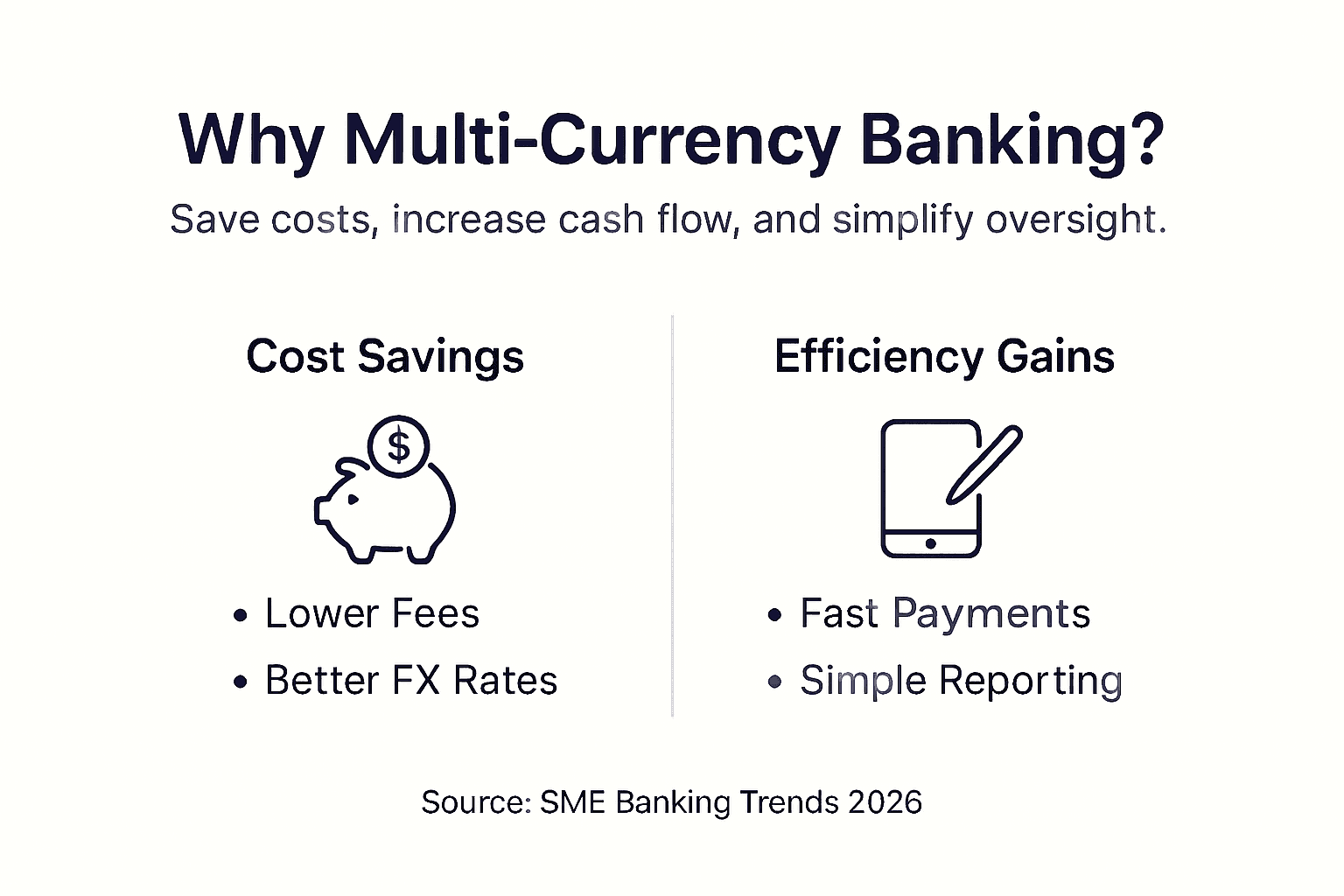
Financial savings from modern multi-currency platforms dramatically exceed traditional banking costs. Savings of 80-99% on FX and transaction fees and up to 75% faster international payment processing represent typical outcomes for businesses migrating from legacy banks to specialized fintech providers.
Operational efficiency improvements materialize through reduced administrative tasks, faster payment execution, and eliminated reconciliation errors. Account setup timelines shrink from weeks of paperwork and branch visits to minutes of online application completion.
| Metric | Traditional Banking | Modern Multi-Currency Platform | Improvement |
|---|---|---|---|
| FX markup | 2-4% above mid-market | 0.1-0.5% above mid-market | 80-95% reduction |
| Transaction fees | €25-€45 per SWIFT | €3-€8 per international payment | 75-90% reduction |
| Payment speed | 3-5 business days | Same day to 24 hours | 60-75% faster |
| Setup time | 2-6 weeks | 10 minutes to 72 hours | 90-95% faster |
| Admin overhead | 15-20 hours monthly | 6-8 hours monthly | 40-60% reduction |
Cash flow visibility improvements through real-time dashboards enable better working capital management and faster response to payment issues. Businesses report 30-50% reduction in payment errors and exceptions requiring manual intervention.
Compliance confidence increases through automated documentation tracking and audit trail maintenance. This reduces regulatory risk and accelerates responses to due diligence requests from partners or auditors.
The SME cost and speed benchmarks for 2026 show continued improvement as competition intensifies among fintech providers and payment infrastructure modernizes across European markets. Early adopters gain competitive advantages through lower costs and faster execution than peers using traditional banking.
Alternative Approaches and Tradeoffs
Traditional banks maintain advantages in credit facilities, relationship banking, and physical branch access for businesses requiring these services. Established institutions offer business loans, overdraft facilities, and trade finance products that pure-play fintech providers cannot match. However, their international business account options lag in cost, speed, and digital experience.
| Feature | Traditional Banks | Fintech Multi-Currency Platforms |
|---|---|---|
| FX rates | 2-4% markup | 0.1-0.5% markup |
| Setup speed | 2-6 weeks | Minutes to 72 hours |
| Digital experience | Basic online banking | Advanced automation and APIs |
| Credit facilities | Loans, overdrafts, trade finance | Limited or none |
| Regulatory scrutiny | Lower for established relationships | Higher for new fintech customers |
| Physical branches | Extensive network | None or minimal |
Fintech platforms excel at payment processing speed, transparency, and cost efficiency for businesses prioritizing these factors over credit access. Virtual IBAN issuance, automated FX conversion, and API-driven payment execution favor fintech architectures.
Tradeoffs include:
- Fintech platforms require stronger documentation and compliance for high-risk sectors
- Traditional banks offer familiarity but slower innovation cycles
- Hybrid approaches using both channels maximize flexibility but increase management complexity
- Regulatory environment continues evolving, affecting both traditional and fintech providers
Your optimal choice depends on credit needs, transaction volumes, risk profile, and operational preferences. Businesses without credit facility requirements and high cross-border payment volumes benefit most from specialized multi-currency fintech platforms. Those requiring loans or trade finance may need hybrid strategies combining traditional banking for credit with fintech for payments.
Streamline Your Banking with Bankz Multi-Currency Solutions
Bankz delivers integrated multi-currency business accounts optimized for European SMEs and high-risk sectors struggling with fragmented traditional banking. Our platform provides local IBANs across multiple jurisdictions, automated foreign exchange conversion, and real-time payment processing through SEPA, SWIFT, and local rails.
Dashboard tools centralize compliance tracking, transaction monitoring, and financial oversight into unified visibility that eliminates platform switching. Digital card issuance and expense management integrate seamlessly with your payment operations. High approval rates and specialized support for gaming, forex, crypto, and other challenging sectors set Bankz apart from providers rejecting complex business models.
Experience the benefits of Bankz multi-currency accounts and business debit Visa cards through simplified onboarding, transparent pricing, and ongoing compliance support. Our international business bank accounts provide the infrastructure European businesses need to compete globally. Discover how Bankz business debit Visa cards streamline expense management and payment execution.
Frequently Asked Questions
What is the difference between virtual and local IBANs for multi-currency banking?
Virtual IBANs are unique account numbers routing to your main account, simplifying payment reconciliation by automatically categorizing incoming funds by source. Local IBANs are actual bank accounts in specific countries, enabling domestic payment processing at local rates and faster settlement times.
How does automation reduce foreign exchange costs in remote banking?
Automated FX systems monitor rate movements continuously and execute conversions at optimal thresholds you define, eliminating manual timing decisions and emotional reactions. This systematic approach captures better rates and removes the opportunity cost of delayed conversions.
What compliance steps are most critical for high-risk industries opening remote accounts?
Prepare comprehensive business model documentation explaining revenue sources, customer types, and risk mitigation procedures. Maintain detailed source of funds evidence, implement robust AML monitoring, and provide transparent operational descriptions addressing provider concerns proactively.
What is the typical approval timeframe for multi-currency accounts on fintech platforms?
Standard business applications receive approval within 24-72 hours for complete submissions with clear documentation. High-risk sectors requiring enhanced due diligence may extend to 7-14 days, while incomplete applications can delay indefinitely until missing information arrives.
What alternatives exist if fintech platforms don't meet my specific banking needs?
Consider hybrid strategies combining traditional banks for credit facilities with fintech platforms for payment processing. Alternatively, explore specialized providers focusing on your industry sector, or work with banking consultants who maintain relationships across multiple institutions and can navigate complex approval processes.