

Managing cross-border payments and multiple currencies often leaves business owners facing unexpected fees, frustrating delays, and complex administrative tasks. Hidden FX markups, slow SWIFT transfers, and disconnected banking systems drain both time and money. Optimizing your business banking setup can reduce costs by up to 80%, accelerate payment processing, and streamline financial workflows. This guide walks you through identifying your banking requirements, selecting the right multi-currency accounts and payment rails, automating workflows, and monitoring your setup to ensure sustained efficiency and cost savings for your European business operations.
Table of Contents
- Key takeaways
- Identify your business banking requirements
- Choose the right multi-currency accounts and payment methods
- Automate workflows and integrate banking with accounting systems
- Monitor, verify, and troubleshoot your banking setup
- Optimize your business banking with Bankz solutions
- Frequently asked questions
Key Takeaways
| Point | Details |
|---|---|
| Multi currency accounts | Holding funds in several currencies with fintech platforms reduces repeated FX and lowers overall costs. |
| SEPA over SWIFT | For euro transfers in Europe, SEPA is cheaper and faster than SWIFT, often delivering next day processing. |
| Automate banking workflows | Integrating accounts with accounting and reconciliation tools saves time and minimizes manual data entry. |
| Hybrid banking balances | Blending fintech and traditional bank balances preserves access to credit while reducing conversion costs. |
Identify your business banking requirements
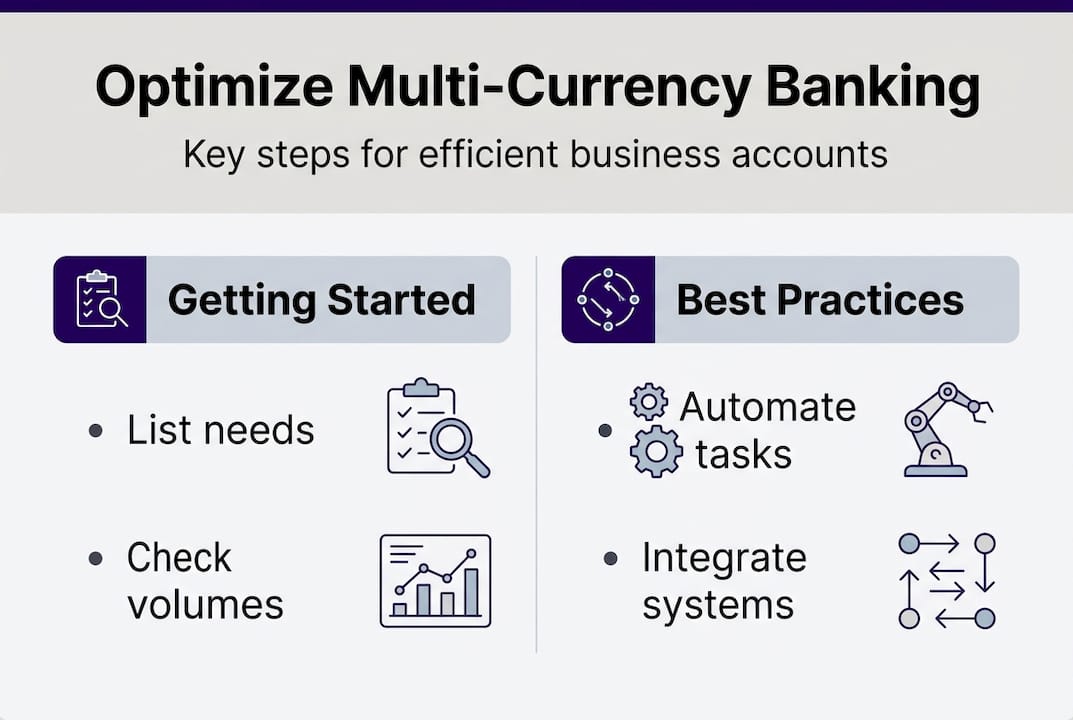
Before selecting accounts or payment methods, map out your specific banking needs to build a foundation for effective optimization. Start by listing every currency your business uses regularly. Do you invoice clients in euros, pounds, and dollars? Do suppliers expect payment in Swiss francs or Swedish krona? Knowing your currency mix prevents costly repeated conversions.
Next, determine transaction volumes for each currency. High-volume currencies justify dedicated local accounts, while occasional currencies may work fine with on-demand conversion. Assess whether you need local IBANs for the Eurozone, UK, or Switzerland to receive payments without intermediary fees or delays. Many European clients and marketplaces require local account details for smooth transactions.
Evaluate your credit requirements carefully. If your business relies on overdrafts, lines of credit, or term loans, traditional banks remain essential partners. However, if you primarily need efficient payment processing without borrowing, multi-currency fintech accounts holding 20-40+ currencies with local IBANs in EU, UK, and Switzerland eliminate repeated FX conversions and associated costs.
Check whether your accounting software requires banking integration. Platforms like Xero and Quickbooks connect seamlessly with modern fintech providers, automating reconciliation and reducing manual data entry. Finally, consider operational controls such as multi-currency cards with spending limits for employees, automated approval workflows, and real-time visibility into balances across currencies.
Pro Tip: Document your monthly transaction volumes by currency and payment destination. This data reveals patterns that guide account selection and helps negotiate better rates with providers.
Understanding these requirements lets you match banking solutions to actual business needs rather than settling for generic offerings. The right setup aligns with how your business operates, where your customers and suppliers are located, and what financial tools your team uses daily. For more background on structuring accounts strategically, explore business bank accounts types for cross-border success.
Choose the right multi-currency accounts and payment methods
Selecting appropriate accounts and payment rails directly impacts your cost structure and payment speed. Multi-currency fintech accounts deliver substantial advantages over traditional banks for cross-border transactions. These platforms let you hold funds in multiple currencies simultaneously, avoiding forced conversions when receiving payments. When you need to exchange currencies, fintech providers offer 80% FX savings versus traditional banks, saving roughly €1,000 per €100,000 exchanged.
For euro payments within the EU, prioritize SEPA over SWIFT. SEPA transfers cost little to nothing and typically complete within one business day, while SWIFT payments carry fees ranging from €15 to €50, take one to five days, and often involve intermediary banks that deduct additional charges. SEPA Instant payments process in seconds for urgent intra-EU euro transfers, though they may carry small premiums over standard SEPA.
SWIFT remains necessary for payments outside the SEPA zone or in non-euro currencies. Emerging markets, certain Asian corridors, and transactions involving currencies like Turkish lira or South African rand require SWIFT infrastructure. For these payments, use SWIFT gpi tracking to monitor progress and identify delays or unexpected deductions.
| Payment method | Best use case | Typical cost | Processing time |
|---|---|---|---|
| SEPA | Intra-EU euro payments | Free to €0.50 | 1 business day |
| SEPA Instant | Urgent euro transfers within EU | €0.50 to €2.00 | Under 10 seconds |
| SWIFT | Non-SEPA currencies or regions | €15 to €50+ | 1 to 5 business days |
| Local rails (UK Faster Payments, Swiss SIC) | Domestic payments in specific countries | Free to €1.00 | Same day to instant |
Combining fintech accounts for payments with traditional banks for credit needs delivers optimal results. Use fintech platforms for receiving international payments, holding multi-currency balances, and executing low-cost transfers. Maintain relationships with traditional banks for overdraft facilities, term loans, and services requiring physical branch access. This hybrid approach balances cost efficiency with comprehensive financial capabilities.

Pro Tip: Open accounts with at least two fintech providers to ensure redundancy. If one platform experiences technical issues or compliance holds, you maintain uninterrupted payment capabilities through your backup account.
The right mix of accounts and payment methods transforms banking from a cost center into a competitive advantage. Lower fees mean better margins, faster payments improve cash flow, and multi-currency flexibility opens new markets without friction. To explore specific fintech features that support SMEs, review fintech accounts features for SMEs.
Automate workflows and integrate banking with accounting systems
Automation eliminates repetitive manual tasks, reduces errors, and gives you real-time visibility into financial positions across currencies. Modern fintech platforms integrate directly with popular accounting systems like Xero and Quickbooks, syncing transactions automatically and eliminating manual data entry. This integration reduces manual processing by 70%, freeing your team to focus on strategic work rather than administrative tasks.
Set up automated reconciliation so that every incoming payment, outgoing transfer, and currency conversion flows into your accounting system without intervention. Configure rules for recurring payments such as supplier invoices, subscription fees, or payroll transfers. Automated workflows can trigger payments based on invoice due dates, apply approval hierarchies for amounts above certain thresholds, and notify relevant team members of exceptions requiring attention.
Multi-currency cards with preset spending limits give employees payment flexibility while maintaining control. Issue virtual cards for online subscriptions and software purchases, physical cards for travel expenses, and department-specific cards with tailored limits. Each transaction appears in your dashboard immediately, categorized by merchant, currency, and cardholder.
Follow these steps to implement effective banking automation:
- Connect your fintech account to your accounting platform using API integration or direct sync features
- Map account categories to your chart of accounts so transactions categorize correctly
- Set up automated rules for recurring payments, FX conversions at target rates, and approval workflows
- Issue multi-currency cards to employees with appropriate limits and merchant category restrictions
- Schedule weekly reconciliation reviews to catch exceptions and refine automation rules
- Monitor integration health through provider dashboards to ensure continuous sync
Automation improves accuracy by eliminating manual transcription errors that plague spreadsheet-based processes. Real-time data lets you monitor cash positions across currencies, identify payment delays immediately, and make informed decisions about currency conversions based on current balances and upcoming obligations.
Pro Tip: Configure automated alerts for low balances in key currencies, large outgoing transfers awaiting approval, and failed payment attempts. Proactive notifications prevent missed payments and overdrafts.
Integrated, automated banking transforms financial management from reactive firefighting to proactive control. You gain complete visibility into where money flows, which currencies you hold, and how efficiently your banking operations run. For comprehensive guidance on managing multiple accounts effectively, see financial management across multiple accounts.
Monitor, verify, and troubleshoot your banking setup
Continuous monitoring ensures your optimized banking setup delivers sustained benefits and helps you identify issues before they become costly problems. Watch for unexpected intermediary fees that appear in SWIFT payments, particularly when sending to countries with less developed banking infrastructure. These fees get deducted from the payment amount, meaning your recipient receives less than you sent.
Compliance processes create another common friction point. AML and KYC requirements can delay transfers unpredictably, especially for high-value payments, transactions to new recipients, or payments involving certain jurisdictions. Maintain complete documentation for all business relationships and be prepared to provide invoices, contracts, or other supporting evidence when requested by your banking provider.
Use SWIFT gpi tracking for international payments outside SEPA to monitor progress in real time. This system shows exactly where your payment sits in the correspondent banking chain and highlights any holds or deductions. Establish internal benchmarks for payment processing times by route and currency, then investigate when actual performance deviates from expectations.
Regularly review FX margins and cost-to-income ratios to verify ongoing efficiency. Compare C/I ratios and straight-through processing rates against industry benchmarks to identify optimization opportunities. If your FX costs creep upward, negotiate better rates with your provider or consider switching to a more competitive platform.
Key metrics to monitor for banking efficiency:
- Average FX margin as percentage of transaction value
- Payment success rate by destination country and currency
- Average processing time for SEPA, SEPA Instant, and SWIFT transfers
- Percentage of transactions requiring manual intervention
- Monthly fees as percentage of total transaction volume
- Frequency of compliance holds or documentation requests
Address increased fraud risk through multi-layered controls. Enable two-factor authentication for all users, set up approval workflows for payments above defined thresholds, and monitor transaction patterns for anomalies. Fraudsters target businesses with cross-border operations, so vigilance pays dividends.
| Common issue | Symptom | Solution |
|---|---|---|
| Intermediary fees | Recipient receives less than sent | Use SEPA for euro payments, SWIFT gpi for tracking |
| Compliance delays | Transfers held for 3-7 days | Provide complete documentation upfront, maintain KYC current |
| High FX costs | Margins exceed 1% | Switch to fintech provider with transparent pricing |
| Failed payments | Rejections due to account details | Verify IBAN/SWIFT codes, use local payment rails |
Troubleshooting becomes straightforward when you maintain detailed records and monitor consistently. Document every optimization change you make and measure results over 30, 60, and 90-day periods. This data proves ROI and guides further improvements. For strategies on streamlining international banking infrastructure, explore streamlining international banking with SEPA and IBAN.
Optimize your business banking with Bankz solutions
Implementing the strategies in this guide becomes simpler with the right banking partner. Bankz offers multi-currency accounts supporting over 40 currencies with local IBANs for the EU, UK, and Switzerland, giving you the infrastructure to receive payments without intermediary fees. Integrated business debit Visa cards enable precise expense control through customizable limits and real-time transaction visibility.
Our solutions focus on automating workflows and minimizing FX and transfer fees so you keep more of what you earn. Whether you need to streamline business banking operations with Bankz multi-currency accounts, leverage business debit visa cards convenience for online payments, or access comprehensive international business bank account solutions, Bankz delivers the tools European SMBs need for efficient cross-border banking. Try Bankz to implement these optimizations with expert support tailored to your business requirements.
Frequently asked questions
What is a multi-currency business account and why is it important?
A multi-currency business account lets you hold, receive, and send payments in multiple currencies without forced conversions. This matters for businesses dealing with international clients and suppliers because it eliminates repeated FX fees and speeds up payment processing. You can maintain balances in euros, pounds, dollars, and other currencies simultaneously, converting only when rates favor you rather than on every transaction.
How does SEPA differ from SWIFT for euro payments?
SEPA is a low-cost, fast euro transfer system within the EU, typically processing in one business day with minimal or zero fees. SWIFT is a global messaging network for international payments that works across currencies and countries but involves higher fees, longer processing times, and intermediary banks that may deduct charges. For euro payments between EU accounts, SEPA delivers better speed and cost efficiency.
Can I automate my business banking to work with my accounting software?
Yes, modern fintech accounts integrate seamlessly with popular accounting platforms like Xero and Quickbooks through API connections. Automation cuts manual work by up to 70% by syncing transactions automatically, categorizing expenses, and reconciling accounts without data entry. This integration improves accuracy, provides real-time financial visibility, and frees your team from repetitive administrative tasks. Learn more about financial management across accounts to maximize these benefits.
What are common challenges with cross-border business payments?
Hidden intermediary fees and FX margin markups increase costs unpredictably, sometimes reducing the amount your recipient receives by 3% to 5%. AML and KYC compliance requirements can delay transfers for days while providers verify documentation, particularly for high-value or unusual transactions. Enhanced fraud risks require robust controls including two-factor authentication, approval workflows, and transaction monitoring to protect your business from unauthorized payments.