

European banking regulations create a maze of compliance requirements that many SME owners and financial managers struggle to navigate. With CRD6 introducing new licensing mandates from 2027 and CRR3 reshaping risk assessments for lending, understanding these frameworks is no longer optional for businesses operating across borders. This guide translates complex regulatory changes into practical insights, helping you protect your operations, reduce costs, and leverage opportunities in Europe's evolving banking landscape.
Table of Contents
- Key takeaways
- Understanding CRD6 and its impact on cross-border banking
- How CRR3 reshapes risk weights and lending assessments
- Navigating cross-border payments and SEPA regulations
- Leveraging RegTech to manage compliance effectively
- Streamline your business banking with Bankz solutions
- Frequently asked questions
Key Takeaways
| Point | Details |
|---|---|
| CRD6 licensing regime | CRD6 creates a licensing regime for non EU institutions providing core banking services across the EU, with branches required by January 2027 unless exemptions apply. |
| Cross border banking review | Review current banking partners to see which non EU institutions provide core services and confirm their CRD6 compliance plans. |
| CRR3 risk weights | ADC and IPRE categories raise risk weights for real estate exposures, increasing required equity and potentially raising borrowing costs. |
| Lending term implications | Transitional arrangements ease the shift, but SMEs should anticipate evolving lending terms during the transition. |
Understanding CRD6 and its impact on cross-border banking
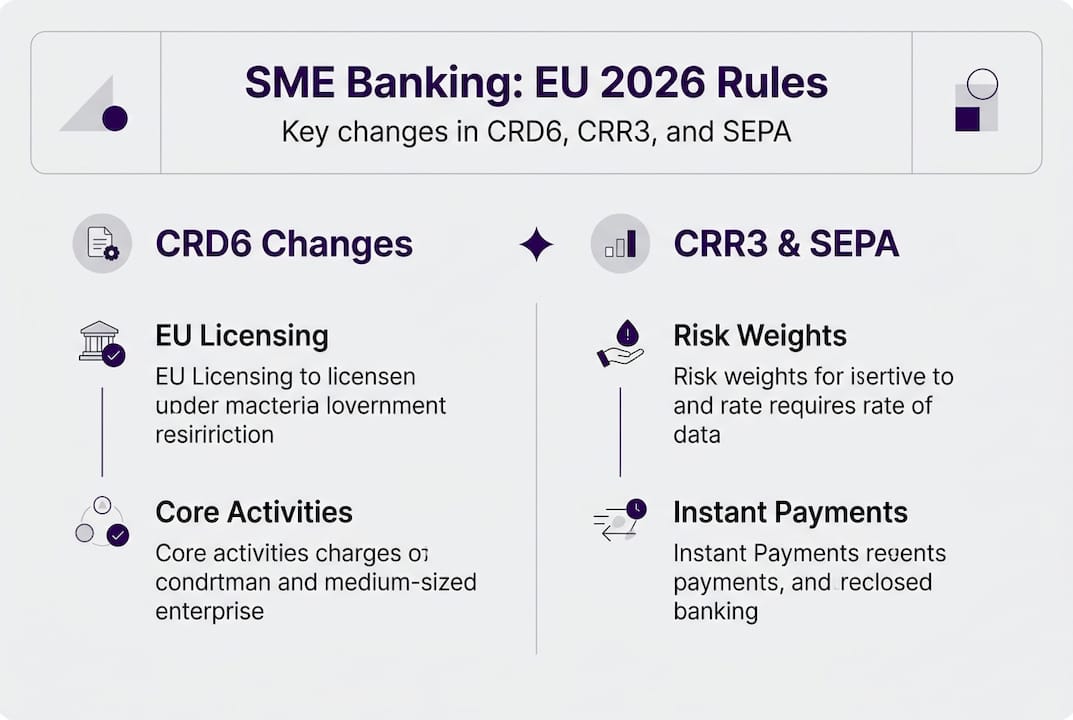
CRD6 introduces a licensing regime for non-EU financial institutions providing core banking activities cross-border into the EU, requiring branches from January 2027 unless exemptions apply. This directive fundamentally changes how non-EU parent companies and their subsidiaries can serve European clients. If your business relies on financial services from institutions outside the EU, you need to understand whether your banking partners must restructure their operations.
Core banking activities under CRD6 include deposit-taking, lending, and issuing guarantees. These are fundamental services that many SMEs use daily for working capital, trade finance, and payment processing. The directive aims to ensure that all institutions offering these services meet EU supervisory standards, regardless of where they're headquartered. This creates a level playing field but also adds complexity for businesses with international banking relationships.
Certain exemptions exist for intra-group transactions and interbank activities, but SMEs must carefully assess whether their arrangements qualify. For example, if your non-EU parent company provides working capital loans to your European subsidiary, this might trigger licensing requirements. Trade finance facilities that involve guarantees or letters of credit could also fall under the core activities definition, requiring your banking partner to establish an EU presence.
Pro Tip: Review your current banking relationships now to identify any non-EU institutions providing core services. Contact them to confirm their CRD6 compliance plans, ensuring continuity of your financial operations beyond 2027.
Practical steps for your business include:
- Audit all cross-border banking relationships to identify non-EU service providers
- Request written confirmation from each institution about their CRD6 compliance strategy
- Evaluate alternative EU-based banking partners as backup options
- Consider switching to business bank accounts for cross-border success that already meet regulatory requirements
The transition period until January 2027 gives you time to adjust, but early action prevents disruption. Many non-EU banks are already establishing branches or partnering with EU institutions to maintain service continuity. Your job is ensuring your business won't face sudden service interruptions when the deadline arrives.
How CRR3 reshapes risk weights and lending assessments
CRR3 standardizes risk weights for real estate exposures, introducing categories like ADC (Acquisition, Development, Construction) and IPRE (Income-producing real estate) with higher risk weights, transitional arrangements, and output floors limiting IRB benefits. This technical change directly affects how banks assess lending risk, which translates to different loan terms and availability for your business.
The new ADC category carries significantly higher risk weights than traditional real estate loans because development projects involve greater uncertainty. If your business seeks financing for property development or significant renovations, expect banks to require more equity contribution and charge higher interest rates. IPRE loans, covering rental properties and commercial real estate investments, also face increased risk weights that make them more expensive from a capital perspective.

| Risk Category | Previous Treatment | CRR3 Treatment | Impact on SME Borrowing |
|---|---|---|---|
| Standard Real Estate | Varied by bank model | Standardized weights | More predictable terms across lenders |
| ADC Loans | Lower risk weights | Higher risk weights | Stricter lending criteria, higher equity requirements |
| IPRE Loans | Internal models varied | Standardized IPRE category | Consistent assessment, potentially tighter terms |
| Output Floor | Limited impact | Caps IRB model benefits | Reduced advantage for borrowers at IRB banks |
Transitional arrangements prevent sudden changes by phasing in the new rules over several years. This gives both banks and borrowers time to adjust their strategies and capital structures. However, the direction is clear: real estate-related lending will require more capital backing from banks, which they'll pass on through pricing and terms.
Output floors limit how much banks can reduce capital requirements using internal risk models. Previously, sophisticated banks could offer better terms by using advanced models to calculate lower risk. CRR3 caps these benefits, narrowing the gap between banks and making lending standards more uniform across the EU. For SMEs, this means less variation in loan offers but potentially fewer opportunities for favorable terms from banks with advanced risk management.
Pro Tip: When seeking real estate financing, present detailed cash flow projections and strong collateral documentation. Banks now scrutinize these deals more carefully under CRR3, so comprehensive preparation improves your approval odds and terms.
Understanding these risk weights helps you negotiate better. If your loan doesn't involve development or income property, emphasize this to secure standard treatment. If it does, prepare for higher equity requirements and consider alternative structures like joint ventures that reduce your borrowing needs. Some SMEs are also exploring banking solutions for high-risk industries that specialize in complex financing arrangements.
Navigating cross-border payments and SEPA regulations
Cross-border payments cost SMEs 10-12 times more outside SEPA, while SEPA Instant became mandatory for euro PSPs by October 2025, enabling SMEs to save over 65% using fintech versus traditional banks. This dramatic cost difference makes payment strategy a critical financial decision for any business operating across European borders. The gap between SEPA and non-SEPA costs stems from correspondent banking fees, currency conversion charges, and processing delays that accumulate quickly.
SEPA Instant payments now settle within 10 seconds, 24/7, across participating countries. This speed eliminates the cash flow delays that previously plagued cross-border transactions, where payments could take 2-3 business days to clear. For SMEs managing tight working capital, this improvement directly enhances liquidity and reduces the need for expensive overdraft facilities to cover timing gaps.
| Payment Method | Average Cost per €10,000 | Settlement Time | Best Use Case |
|---|---|---|---|
| SEPA Credit Transfer | €0-5 | 1 business day | Regular supplier payments |
| SEPA Instant | €0-10 | Under 10 seconds | Urgent payments, just-in-time inventory |
| Traditional Cross-Border (non-SEPA) | €50-120 | 2-5 business days | Legacy relationships only |
| Fintech Platform | €5-20 | Same day to instant | High-volume cross-border operations |
Multi-currency operations benefit from holding local accounts to avoid FX fees of 1-3% and leveraging fintech for cross-border payments. When you maintain euro, pound, and other currency balances, you can receive payments without conversion, pay suppliers in their currency, and choose optimal timing for any necessary exchanges. This flexibility saves thousands annually for businesses with regular multi-currency flows.
Foreign exchange fees of 1-3% might seem small, but they compound rapidly. A business processing €500,000 annually in cross-border payments pays €5,000-€15,000 in FX fees alone. By holding multi-currency accounts and using competitive fintech platforms for necessary conversions, you can cut this cost by 60-80%, redirecting those savings to growth investments.
Practical recommendations for optimizing your payment operations:
- Transition all euro-zone payments to SEPA Instant for speed and cost efficiency
- Open multi-currency accounts to hold balances in your primary operating currencies
- Compare fintech platforms against your current bank for cross-border payment pricing
- Negotiate volume discounts with payment providers if you process significant transaction values
- Use SEPA and IBAN in digital banking to understand technical requirements
The G20 roadmap for instant payment interoperability promises further improvements by connecting instant payment systems globally. While full implementation remains years away, the direction is clear: payment costs will continue falling, and speed will become standard. SMEs that adopt these systems now gain competitive advantages in supplier negotiations and customer service. Exploring fintech accounts for SMEs can accelerate this transition with purpose-built tools for cross-border operations.
Leveraging RegTech to manage compliance effectively
RegTech and SupTech reduce compliance burden by 15-20% through automation for SMEs handling multi-currency transactions under PSD2 and CRR frameworks. This reduction translates to fewer staff hours spent on manual checks, lower error rates, and faster response times to regulatory requirements. For resource-constrained SMEs, these efficiency gains directly impact profitability and growth capacity.
RegTech tools automate critical compliance tasks including AML (Anti-Money Laundering) screening, transaction monitoring, and XBRL financial reporting. Traditional manual processes require staff to check customer identities against sanction lists, review transaction patterns for suspicious activity, and format financial reports to regulatory specifications. Automation handles these tasks continuously, flagging only genuine concerns for human review.
SMEs engaged in multi-currency operations face heightened compliance scrutiny because cross-border transactions carry higher money laundering risk in regulators' eyes. RegTech solutions monitor transactions in real time, applying sophisticated algorithms to distinguish legitimate business patterns from suspicious activity. This capability protects your business from both regulatory violations and actual financial crime that could damage your reputation.
The 15-20% compliance burden reduction frees your team to focus on revenue-generating activities rather than paperwork. For a small finance team spending 10 hours weekly on compliance tasks, automation recovers 1.5-2 hours that can shift to financial planning, vendor negotiations, or customer relationship management. Over a year, this compounds to 75-100 hours of productive capacity.
Key RegTech capabilities valuable for SMEs:
- Automated customer due diligence and KYC (Know Your Customer) verification at onboarding
- Real-time transaction monitoring with customizable risk rules for your business model
- Regulatory reporting automation for PSD2, AML directives, and tax requirements
- Audit trail generation that documents compliance activities for regulatory reviews
- Integration with banking platforms to centralize compliance data
Pro Tip: Start with RegTech tools that integrate directly with your banking platform rather than standalone solutions. Integration reduces data entry, minimizes errors, and provides a unified view of compliance status across all financial activities.
Combining RegTech with sound banking practices creates a robust compliance framework. Choose banking partners that offer built-in compliance tools, maintain clear documentation of your business activities, and conduct periodic internal reviews to ensure processes remain current with regulatory changes. This proactive approach prevents violations before they occur and demonstrates good faith to regulators if questions arise. Resources like streamlining international banking with SEPA and IBAN can help you build compliant operational frameworks from the start.
Streamline your business banking with Bankz solutions
Navigating European banking regulations becomes significantly easier when you work with platforms designed specifically for cross-border SME operations. Bankz offers multi-currency business accounts that let you hold euros, pounds, and other currencies in a single dashboard, eliminating the FX fees and delays that drain profits from international transactions. You can receive payments in multiple currencies, pay suppliers in their preferred currency, and convert funds only when rates favor your business.
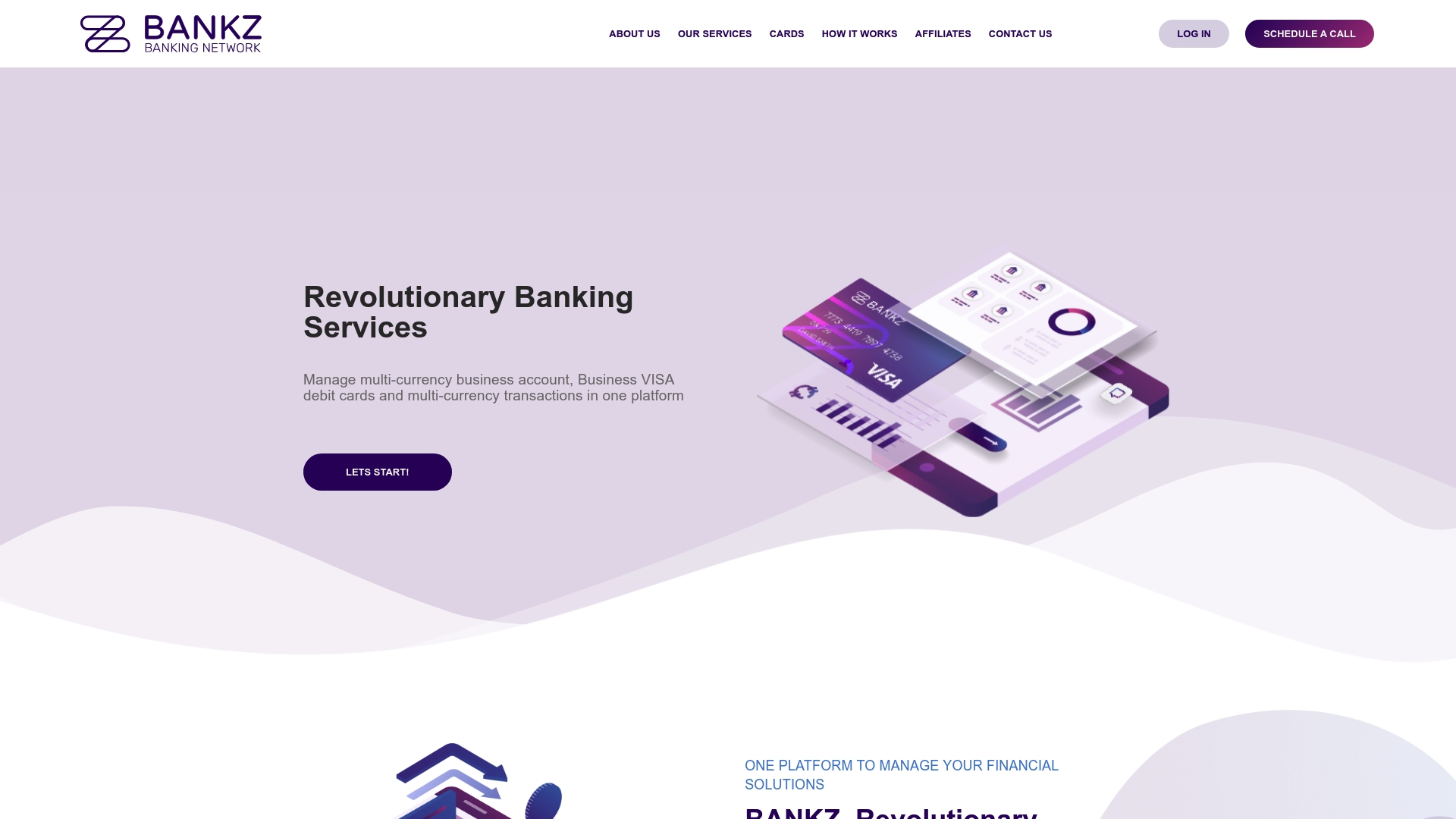
Bankz business debit Visa cards provide the payment flexibility you need for both online purchases and in-person transactions across Europe. These cards link directly to your multi-currency accounts, automatically using the appropriate currency balance and avoiding unnecessary conversions. For businesses managing teams or multiple expense categories, Bankz supports multiple cards with individual spending controls and real-time transaction visibility.
The platform's design specifically addresses the compliance challenges discussed throughout this guide. With built-in SEPA payment capabilities, automated transaction categorization, and regulatory reporting features, Bankz helps you meet PSD2 and other requirements without manual intervention. This integration means you spend less time on banking administration and more time growing your business. Explore how to streamline your business banking operations with purpose-built tools, discover the convenience of business debit visa cards for modern operations, or review comprehensive international business bank account solutions tailored for cross-border success.
Frequently asked questions
What is CRD6 and how does it affect non-EU financial institutions?
CRD6 requires non-EU financial firms to obtain licenses or establish branches in the EU for providing core banking activities starting January 2027. Core activities include deposit-taking, lending, and issuing guarantees. Institutions that fail to comply will lose the ability to offer these services cross-border to EU clients, potentially disrupting existing banking relationships for SMEs relying on non-EU providers.
How do SEPA Instant payments benefit SMEs in cross-border transactions?
SEPA Instant enables euro payments to settle within 10 seconds, 24/7, across participating European countries. This speed eliminates the 2-3 day delays of traditional transfers, dramatically improving cash flow management for SMEs. The mandatory adoption by euro Payment Service Providers since October 2025 also drove costs down by over 65% compared to traditional banking, making cross-border payments affordable for even small transaction volumes.
What are the new real estate loan categories under CRR3?
CRR3 introduces ADC (Acquisition, Development, Construction) and IPRE (Income-producing real estate) as distinct loan categories with higher risk weights. ADC covers property development projects and carries significantly elevated risk weights due to project uncertainty. IPRE applies to rental properties and commercial real estate investments. These categorizations standardize how banks assess real estate lending risk, generally making such loans more expensive and requiring higher equity contributions from borrowers.
Why should SMEs hold multi-currency accounts?
Multi-currency accounts eliminate foreign exchange fees of 1-3% that banks charge on currency conversions. When you hold balances in euros, pounds, and other currencies you regularly use, you can receive payments without conversion, pay suppliers in their currency, and choose optimal timing for exchanges. For businesses processing significant cross-border volumes, this flexibility saves thousands annually while improving cash flow predictability and reducing exposure to unfavorable exchange rate timing.
What are best practices for SMEs to manage compliance under these regulations?
Implement RegTech tools to automate AML screening, transaction monitoring, and financial reporting, reducing manual workload by 15-20%. Review your business structure and banking relationships quarterly to ensure ongoing compliance with evolving requirements like CRD6 licensing mandates. Maintain multi-currency accounts with compliant EU-based providers to control FX costs while meeting regulatory standards. Document all compliance activities thoroughly to demonstrate good faith during regulatory reviews and simplify audit processes.